
Introduction
Commercial dairies are quietly replacing rigid high density polyethylene (HDPE) lines. Packaging equations for fluid milk have changed. From the unstable supply of feedstocks, the growing Extended Producer Responsibility (EPR) legislation, to the increased litigation liability around microplastic, the economic story of single-use containers is not holding together. The era of the glass bottle is not being seen as a relic of some older ideas about branding and selling dairy products at the local farm stand, but as a manufactured, high-throughput asset class being reconsidered by modern dairy producers. When it comes to working with a specialized glass milk bottle manufacturer, you need to be more than just looking at the glossy sales sheets and be ready to go deep into furnace chemistry, wall-thickness uniformity tolerances and high-speed filling line survivability metrics
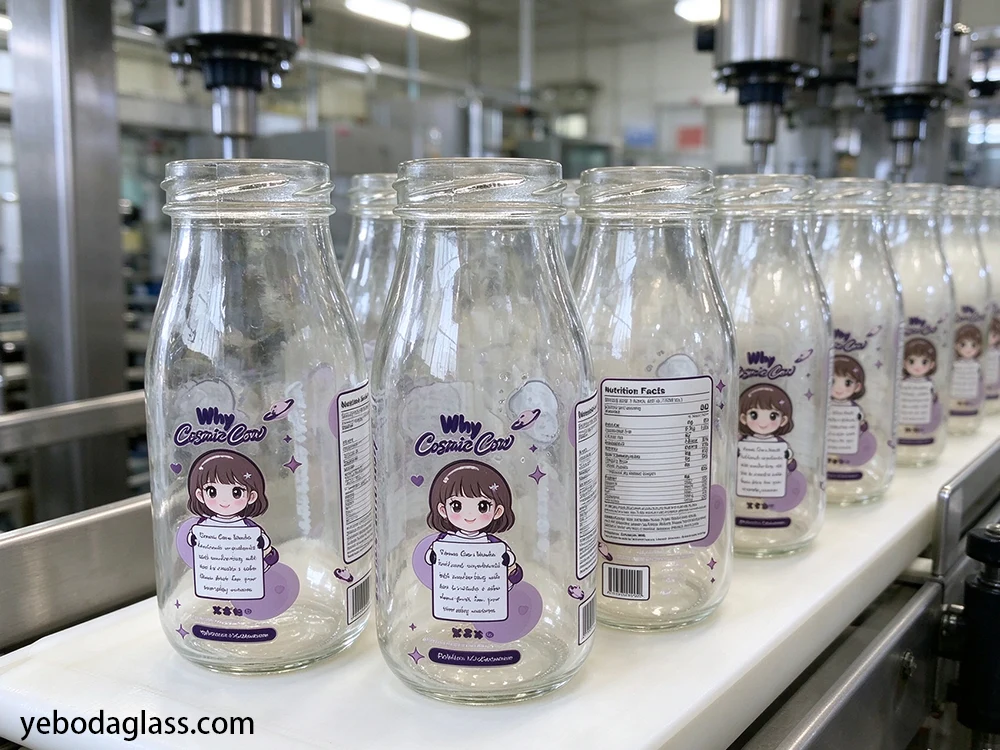
The Engineering Shifts: Lightweighting and Furnace Physics
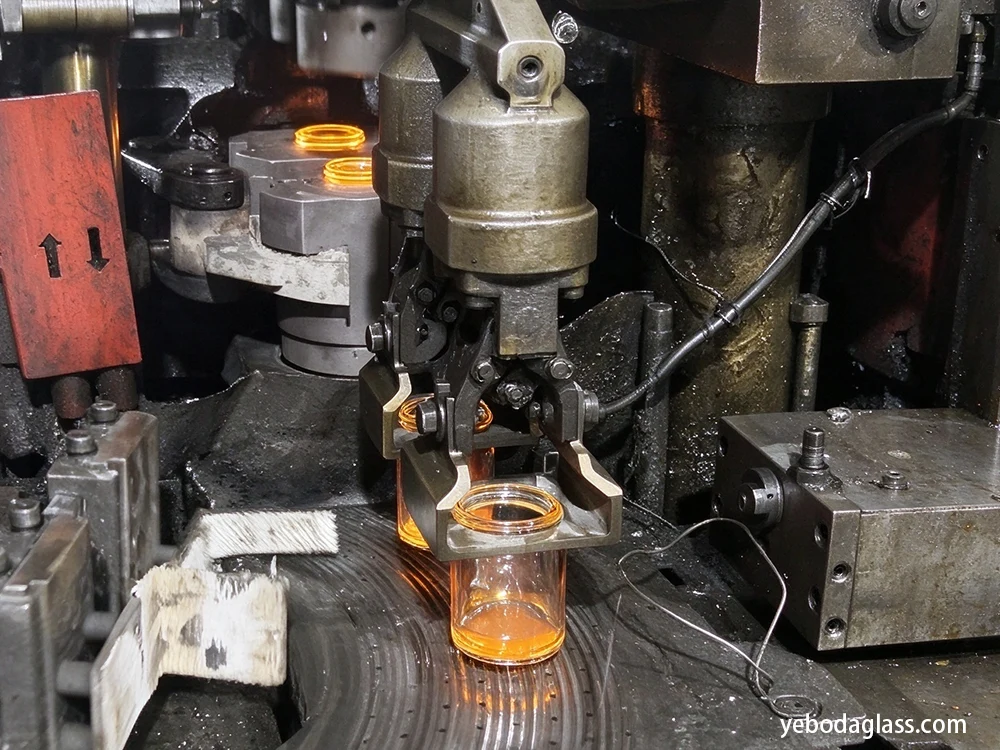
The manufacturing of glass in 2027 is a physics and logistics question. A typical 1 litre traditional returnable bottle weighed between 420g and 480g. That extra weight increased the margins of the supply chain but caused freight efficiency to drop and fuel surcharges to rise. Today, the tier-one glass plants can use advanced narrow-neck press-and-blow (NNPB) forming technology to reduce the bottle weight to 260-290 grams without breaking the structure. Manufacturers can introduce exact air pressure changes in the mould during molding; this removes the problem of uneven glass internal distribution from the legacy blow-and-blow molding processes. The outcome is a lighter, more robust container that can resist vertical load pressure of 1.8 Mega-Pascals and thermal shock up to 42 degrees Celsius, which are important parameters in automated caustic wash cycles and fast fill lines (300 units per minute) for flash-pasteurization. Analyzing dairy packaging trends in 2027 shows that sustainability is more than just about recyclability—it’s about trip-life economics. Expensive, a single use PET bottle costs only $0.08 per unit, but also has a dead end lifecycle cost and escalating compliance costs. On the other hand, a strong, returnable glass container designed by commercial dairy bottle manufacturers requires about $0.45 to make, and can be returned 35 to 50 times before an optical stress scanner rejects it for remelting. This reduces the container cost per fill to under $0.012. To obtain those economics, the surface treatment protocols used at the hot end and cold end of the annealing lehr are checked. Glass-on-glass abrasion on high-speed conveyor lines, without the use of a pyrolytic titanium tetrachloride (TiO2) hot-end application and polyethylene wax cold-end spray, causes the bottle tensile strength to drop by up to 60 percent after a mere three washer trips.
Unit Costs, Trippage Metrics, and Material Comparatives
| Technical Parameter | Legacy Glass Bottle (Pre-2020) | 2027 NNPB Lightweight Glass | Standard HDPE / PET Plastic |
| Average Tare Weight (1-Liter) | 450 g | 275 g | 38 g |
| Average Operational Lifespan | 20 – 25 Trippage Cycles | 40 – 50 Trippage Cycles | 1 Single Use |
| Thermal Shock Tolerance ($\Delta T$) | 30掳C – 35掳C | $\ge 42^\circ\text{C}$ | Non-applicable ($<65^\circ\text{C}$ melt threshold) |
| Vertical Crush Load Limit | 1.2 MPa | 1.85 MPa | 0.45 MPa |
| Chemical Leaching / Gas Permeability | Zero / Absolute Barrier | Zero / Absolute Barrier | Microplastic Risk / Oxygen Permeable |
| Effective Container Cost Per Fill | $0.022 (Over 20 trips) | $0.009 (Over 50 trips) | $0.085 (Single purchase) |
The changeover of a processing plant to sustainable glass milk bottles requires an understanding of the subtle mechanics of the new closures and fill-head dynamics. Mechanical stress points are quite different from plastic lines. If the force applied by capping turrets is too great, it can cause micro-fractures to the bead finish used on the bottle neck, which could lead to cracking the seal.If too much force is applied by the turrets, the bead finish on the bottle neck may get micro fractured, resulting in a break in the seal. Expanding a dairy’s wholesale business should not be done at the cost of good looks. Co–3350 deep ambers and UV-blocking glass are gaining traction in the high-fat organic milk sector and A2 dairy products due to the potential for light-induced oxidation of riboflavin (Vitamin B2) that can create off-flavors within the first 6 hours of retail exposure to fluorescent light. For fresh white milk, the flint glass most commonly used is intended for recycling after the product has been consumed by consumers. The quantity of post-consumer recycled flint glass used in the melt batch should be a minimum of 70 percent as this will reduce furnace burn temperatures and improve scope-3 embodied carbon.
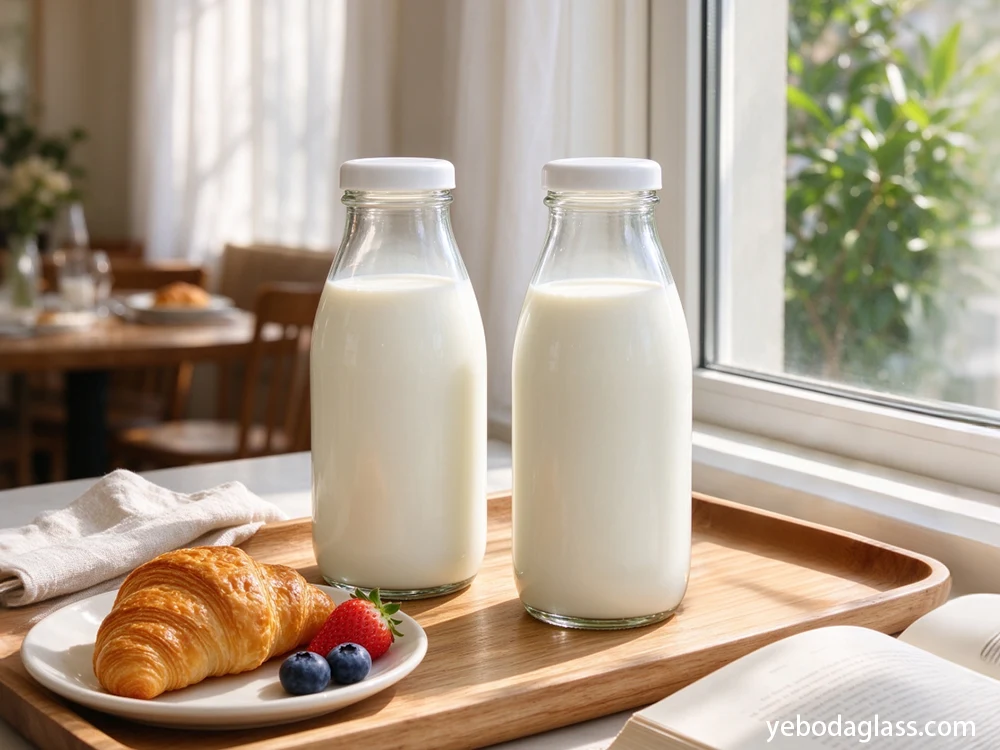
Quality Audits and Line Survivability Metrics
The knowledge of selecting glass milk bottle manufacturer for bulk orders is to examine factory’s quality assurance system, not just to take the paper certificate for granted. Check the hot-end automatic inspection system. A reputable factory uses multi-axis high speed optical camera systems, polariscopes for measuring residual stress and continuous wall thickness radar sensors, all located right on the drop line. If a supplier is checking the quality by hand at the packing station using random sample of batches then move on them. An out-of-spec neck thread and/or an off-center base push-up will jam a star wheel, resulting in line downtime and thousands of dollars per hour in spilled product and broken glass cleanups in high-speed automated bottling lines.
| Vendor Metric & Audit Checklist | Target Benchmark Standard | Red Flag / Non-Compliance Indicator | Impact on Bottling Operations |
| Annealing Stress Grade (ASTM C148) | Temper Number $\le 2$ (Low residual stress) | Temper Number $\ge 4$ (High internal stress) | High breakage rate during sudden temperature changes in pasteurization |
| Wall Thickness Uniformity Ratio | $\le 1.5 : 1$ ratio between thick and thin walls | $\ge 2.2 : 1$ ratio (Thin spots on corners) | Structural collapse under vertical capping pressure |
| Hot/Cold End Surface Coating Thickness | 10 to 15 CTU (Coating Thickness Units) | $< 5$ CTU or uneven manual spray | Rapid scuffing, surface scratches, and line jams |
| Cullet Integration Percentage | 60% to 75% Post-Consumer Recycled Glass | $< 25\%$ (Pure virgin raw batch melt) | Higher carbon footprint and elevated thermal expansion rates |
| Dimensional Tolerance Variance | $\pm 0.8\text{ mm}$ on height; $\pm 0.5\text{ mm}$ on finish | $>\pm 1.8\text{ mm}$ variance across production lots | Vacuum leaks at cap seal and fill-level inconsistency |
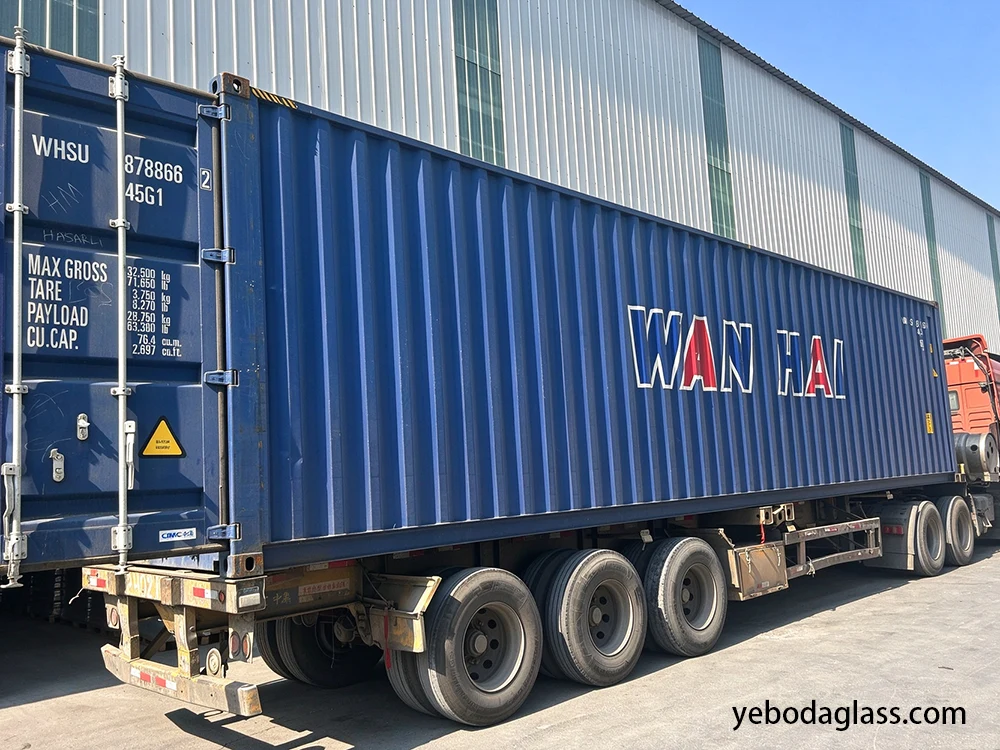
Consider the shipping configurations and palletization standards when purchasing environmentally friendly glass milk containers. Glass is heavy cargo and shipping air in empty containers erodes profitability from regional distribution systems. Collaborate cooperatively with commercial vendors providing modular and inter-stackable plastic crates designed for NNPB bottle shapes. In addition, negotiate direct logistics from the factory to the plant with bulk shrink-wrapped tier sheets on heavy duty plastic pallets instead of low grade wood skids that drop wood chips into open bottle-mouths. Locking up long-term supply agreements with a dairy packaging manufacturer that has experience in the specialty packaging field gives the high volume regional processor the mold exclusivity, custom debossing options, and safety stock assurances necessary to produce a continuous volume of product in the plant on a consistent basis, particularly during peak seasonal demand.
Frequently Asked Questions
How does narrow-neck press-and-blow (NNPB) technology lower total packaging costs for commercial dairies?
In the NNPB technology the manufacturers can get a more uniform and even distribution of the molten glass throughout the mold cavity, avoiding too much weight that is usual in conventional blow-and-blow molding. This process reduces the weight of the bottles by as much as 35% without compromising on structural strength, thereby helping the plants to save on inbound and outbound freight costs, increase the payloads in the trucks and lower energy consumption during washing cycles.
What is the specific coating that should be used to make glass containers withstand 30+ wash cycles?
Glass containers need a double-packaging system. A thin layer of the chemical titanium tetrachloride is placed at the hot end of the manufacturing line (around 540°C) to form an iron-clad bonding layer. A water based polyethylene or oleic acid coating is sprayed on at the cold end (around 150°C). The combination results in a surface with low friction that avoids scratching of the glass on reuse, and maintains the strength of the structural walls for decades.
What is causing the popularity of the UV blocking and amber glass bottles for high-quality dairy products?
Oxidation induced by store lighting, reduces milk fat quality and will destroy key milk vitamins such as riboflavin in hours, resulting in changes in milk taste and reducing shelf life. The coloured glass formulations (amber or U.V. filtering) block the light wavelengths below 450 nanometres. This protective barrier helps retain flavor and ensures retail freshness with organic, pasture-raised or high-fat milk products.
What is the minimum thermal shock of automatic dairy pasteurization and wash lines?
Commercial glass milk containers should be able to handle at least a 42°C thermal shock differential (\(\Delta T\)) without cracking. This margin guarantees that bottles can be safely transported from cold storage through the hot temperature range of the caustic wash cycle (usually 65°C to 75°C), and be immediately placed in cold water for rinsing without any base seams failing or micro-fracturing.
Looking for the right dairy bottling line container that’s lightweight, high-durability, designed for maximum trip-life and automated performance? Discuss custom mold options, request certified ASTM lab testing reports or audits of our high-speed manufacturing facilities with our technical engineering team today.
 EN
 FR
 DE
 IT
 ES
 CS
 PT
 NL
 PL
 TR
 AR
 KO
 JA
 ZH
 RU
 HU