
It happens fast.
One second the yogurt line is running normally, stainless-steel nozzles dispensing product at 58°C into freshly unpacked 玻璃罐, conveyors humming, operators relaxed. Then comes the sound everyone in dairy packaging remembers.
A sharp crack.
然后又一个。
And suddenly the line stops because a pallet of “temperature-rated” yogurt jars is failing even though the filling temperature is technically below the supplier’s stated limit.
So what happened?
Simple answer: temperature limits on paper are often measured under controlled laboratory conditions, while real production lines create layered thermal stress that most factories never fully explain to buyers.
And honestly, some suppliers do not even understand the difference themselves.
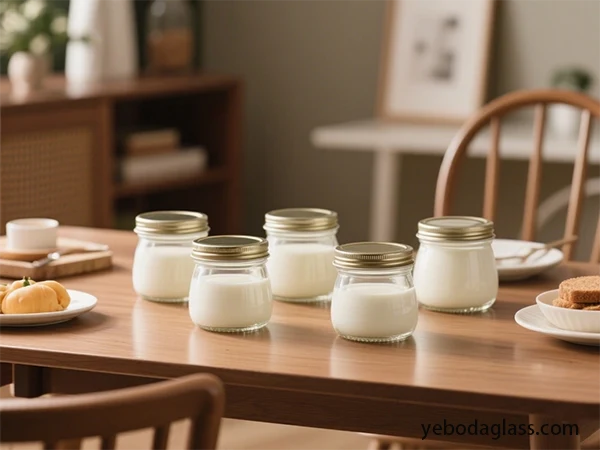
Why glass yogurt jar hot filling cracking happens below the stated limit
This confuses buyers.
A supplier says the jar is safe up to 70°C. Your yogurt enters at 58°C. Yet the jar still fractures. The assumption is usually that the 玻璃罐工厂 lied.
Not always.
Sometimes the problem is worse than dishonesty.
It is oversimplification.
Because “maximum temperature” is not the same thing as thermal shock resistance.
Those are two completely different engineering concepts.
A jar may survive holding liquid at 70°C steadily. But if that same jar starts at 18°C warehouse temperature and suddenly receives 58°C product in under two seconds, the thermal gradient across the glass wall becomes highly uneven.
That uneven expansion creates stress.
And glass hates uneven stress.
The thermal shock myth most packaging suppliers repeat
I hear this constantly:
“Our jars can withstand 80°C.”
Fine.
For how long? Under what wall thickness distribution? With what annealing profile? Empty or filled? Static or moving? Single-use or reused?
Silence.
Because many factories test only ideal conditions.
Real yogurt production lines are messy systems involving:
- Rapid filling cycles
- Conveyor vibration
- Cold warehouse storage
- Residual moisture
- Lid compression stress
- Uneven glass geometry
- Filling speed variation
Those variables stack together.
And stacked stress breaks glass.
According to the U.S. Food and Drug Administration food-contact packaging guidance, packaging materials must remain stable under intended use conditions, but the responsibility for validating actual production conditions falls heavily on manufacturers and buyers.
That’s where many procurement teams underestimate risk.
The real engineering cause: thermal gradient stress
Here is the issue.
Glass expands when heated. But it does not heat evenly.
The inside surface touching hot yogurt expands first while the outer wall remains relatively cool. If the temperature differential exceeds the structural tolerance of the jar, stress accumulates faster than the material can absorb.
Then fracture.
Not because the temperature is “too high.”
Because the temperature changed too fast.
Why uneven wall thickness makes the problem worse
This part matters more than most buyers realize.
A yogurt jar with 3.2 mm thickness on one side and 2.5 mm on another does not absorb heat uniformly. Thinner regions expand faster. Thicker areas lag behind.
That mismatch creates localized stress concentration.
The scary part?
Many jars pass visual inspection while still having dangerous thickness variation.
I’ve measured production batches where the deviation exceeded 0.6 mm, which is enough to alter thermal response significantly during hot filling.
Yet suppliers still called the jars “within standard.”
Glass food jar annealing defects are often invisible
You cannot see internal stress easily.
That is why annealing matters.
Annealing is the controlled cooling process after forming. If jars cool too quickly, residual stress remains trapped inside the glass structure. The jar may appear perfect but already contains internal tension waiting for an external trigger.
Hot filling becomes that trigger.
The National Institute of Standards and Technology materials research database has repeatedly documented how residual stress in glass structures dramatically reduces resistance to thermal shock and mechanical loading.
But many buyers never ask for annealing data.
They ask only for price.
That is the expensive mistake.
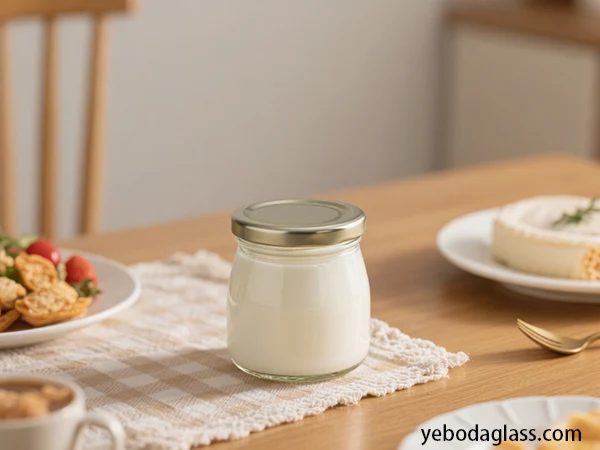
Why reusable dairy jars fail more often over time
Glass fatigue is real.
Factories rarely market that fact because “reusable” sounds environmentally friendly and premium. But every reuse cycle adds microscopic stress to the structure.
Especially in dairy operations where jars experience:
- 冷藏
- Hot washing
- Conveyor impact
- Lid compression cycles
- Rapid reheating
A reusable yogurt jar may survive 5 cycles flawlessly and fail on cycle 11 without visible warning.
That unpredictability is exactly why professional dairy brands track reuse-cycle failure rates internally.
Real-world industry pressure behind declining consistency
This industry changed after 2023.
Energy prices rose. Furnace operations became more expensive. Many glass factories extended mold life beyond optimal replacement windows to reduce downtime.
That affects quality directly.
According to Reuters manufacturing and energy market coverage, energy-intensive industries including container glass manufacturing have faced major cost pressure since 2024, forcing operational efficiency measures across global production lines.
Translation?
Some factories reduced quality margins to protect profitability.
Longer mold cycles create:
More seam variation
Thickness inconsistency
Neck finish distortion
Residual stress variability
And those weaknesses appear first during thermal loading.
Exactly where yogurt producers least want failure.
Hot fill glass jar quality control most factories do not explain
Let me be blunt.
Many “QC reports” are cosmetic paperwork.
Real thermal-shock-resistant yogurt jar testing should include:
Polarized stress inspection
This reveals residual internal stress invisible to the naked eye.
Thermal shock cycling
例子:
- 20°C empty jar
- Fill with 60°C liquid
- Cool rapidly to 25°C
- Repeat multiple cycles
Ultrasonic wall thickness mapping
Not just one measurement point.
Multiple zones.
Rim compression testing
Lid torque affects thermal stress concentration around the neck.
Impact + heat combination testing
Because transport vibration changes structural stability before filling even begins.
Acceptable temperature limit for glass yogurt jars is often misunderstood
Temperature rating alone means very little without context.
Here’s a better framework:
| Condition | Low Risk | Medium Risk | High Risk |
| Jar preheated before fill | 是的 | ||
| Cold jar + hot yogurt | 是的 | ||
| Uneven wall thickness | 是的 | 高的 | |
| Poor annealing quality | 高的 | ||
| Reused jar cycles >10 | 是的 | 高的 | |
| Sudden cooling after fill | 高的 |
This table explains more than most supplier catalogs ever will.
Why small defects become major failures during filling
Tiny defects matter.
Especially under thermal stress.
Common hidden defects include:
Micro-cracks near shoulder
Mold seam stress points
Air bubble inclusions
Surface scratches from transport
Base asymmetry
Under room temperature conditions, these defects may remain harmless.
Under rapid thermal expansion?
Different story entirely.

Bubble inclusions are more dangerous than suppliers admit
A small enclosed bubble interrupts structural continuity. That changes stress distribution around the defect.
Is every bubble catastrophic?
No.
But bubbles near high-stress regions—especially shoulder transitions—can significantly reduce thermal resistance.
Factories know this.
They just prefer calling them “cosmetic.”
How to prevent yogurt jars from cracking during filling
There are solutions.
But they require discipline.
Use gradual temperature transition
Prewarming jars reduces thermal differential dramatically.
Specify tighter thickness tolerances
Professional buyers often require:
- ±0.3 mm maximum variation
- Documented thickness mapping
Request annealing inspection data
- Not generic certificates.
- Actual stress testing records.
Reduce conveyor shock before filling
Micro-damage from handling accumulates invisibly.
Conduct real production simulation testing
Lab tests are not enough.
Simulate actual filling speed and temperature change.
Comparison of common yogurt jar failure causes
| Failure Cause | Visible Before Filling? | 风险等级 | Common Supplier Explanation |
| Uneven wall thickness | Rarely | 高的 | “Within tolerance” |
| Poor annealing | 不 | 高的 | Usually ignored |
| Mold seam weakness | 是的 | 中等的 | “Cosmetic only” |
| Thermal shock | 不 | 高的 | “Temperature too high” |
| Micro-cracks from transport | 不 | 高的 | “Shipping issue” |
| Lid compression stress | Rarely | 中等的 | “Cap supplier problem” |
The procurement mistake many importers repeat
They optimize price first.
Then quality later.
That sequence almost always backfires in glass packaging.
Because once a production line starts cracking jars during filling, the real cost is no longer the jar itself.
It becomes:
停机时间
Product contamination
Labor stoppage
Waste disposal
Retail delays
Customer claims
One fractured yogurt jar can destroy far more value than its unit price suggests.
常见问题解答
Why do glass yogurt jars crack during hot filling below the temperature limit?
Glass yogurt jars crack during hot filling below the stated temperature limit because thermal shock resistance depends not only on temperature but also on heating speed, wall thickness uniformity, annealing quality, and residual internal stress within the glass structure.
This means a jar can fail even when technically operating “within spec.”
What does it mean to be thermal shock resistant in a yogurt jar?
Thermal shock resistance describes how a glass yogurt cup will react when temperatures fluctuate quickly, typically by glass composition, thickness uniformity and during glass manufacturing, by the process called “annealing.
There’s more than just the maximum temperature rating.
Does the thickness of the wall of a Yogurt Jar affect that the product will crack?
The uneven wall thickness is responsible for the yogurt jar cracking due to different rate of expansion of different parts of the glass during hot filling, which results in different stress concentrations within the glass material, which exceeds its tensile strength.
Performance can be dramatically impacted by slight changes in thickness.
How do manufacturers test hot fill yogurt jars?
Manufacturers test hot fill yogurt jars using thermal shock cycling, polarized stress analysis, wall thickness mapping, and compression testing to evaluate resistance under rapid temperature transition conditions.
Advanced factories simulate real production-line conditions during testing.
Are reusable dairy jars more likely to crack?
Reusable dairy jars are more likely to crack over time because repeated washing, filling, cooling, and mechanical handling gradually increase microscopic structural fatigue inside the glass.
Failure risk rises significantly after multiple reuse cycles.
Are reusable dairy jars more likely to crack?
Reusable dairy jars are more likely to crack over time because repeated washing, filling, cooling, and mechanical handling gradually increase microscopic structural fatigue inside the glass.
Failure risk rises significantly after multiple reuse cycles.
The hard truth from inside the glass industry
Glass remembers stress.
That is the reality suppliers rarely explain clearly.
A yogurt jar does not suddenly “decide” to crack during hot filling. The weakness usually existed long before the product touched the container. The filling process simply exposed what production shortcuts, transport handling, or poor annealing already built into the glass.
And that is why buyers who only compare unit price usually end up paying far more later.
行动号召
If you are sourcing glass yogurt jars for hot-fill dairy production, we can provide thermal shock testing reports, annealing inspection data, wall thickness mapping, and production simulation samples before bulk manufacturing.
Contact us today for free samples and detailed quality specifications for your next yogurt jar order.

 ZH
ZH  EN
EN  FR
FR  DE
DE  IT
IT  ES
ES  CS
CS  PT
PT  NL
NL  PL
PL  TR
TR  AR
AR  KO
KO  JA
JA  RU
RU  HU
HU