
Bevezetés
A simple visual test may not be the best way to get a handle on the situation when it comes to a glass milk bottle.
A slightly misshapen neck can make it difficult to fit a cap properly. If there is an unstable base, this can create issues on a filling line. An unnoticed crack in a bottle can be broken while it’s being transported or handled.
The implications are not just about the bottle though. A small margin on the initial purchase price can easily be offset by leakage, rejected batches, production stoppages and customer complaints.
Therefore, for dairy processors, distributors, and glass milk bottle importers, the selection of glass milk bottle wholesaler is not just a sourcing task, but also a decision on quality management.
The question is simple: how does a supplier show the 5,000 or 50,000 bottles are all equally compliant with agreed upon specs?
Material Selection: Quality Starts Before Bottle Forming
The soda-lime glass is used for the manufacture of most conventional üveg tejesüvegek. The wide availability, practical cost and proven performance of it make it a popular choice for packaging of food and beverages.
The term “food-grade glass” should never be taken at face value, however.
Purchasers should be aware of application, content, seal and also any coating or decoration of the completed bottle. The requirements of a bottle used for single use packaging can differ from those used for repeated washable and re-use packaging.
Expect a responsible wholesaler to be able to give you information on the material and product specs and details. Buyers should also check food-contact requirements, where applicable, for regulated markets.
EU Regulation (EC) No 1935/2004, for instance, sets general requirements for materials and articles which are intended to come into contact with food. They should not transfer constituents into food at concentrations that may pose a risk of harm to human health or lead to a “taste or odor that is unwanted”.
The Food Contact Materials (FCM) Regulations (European Commission) refer to these.
Standard Glass Milk Bottles and Reusable Glass Milk Bottles
The selection of a sample is easy. Repeatability is harder.
The production conditions affect the size, wall distribution, surface quality, and uniformity of the bottle during glass forming. Finished bottles may be different if there are variations in process conditions, which will only become apparent when larger numbers are examined.
There are multiple steps that should be included in a professional glass bottle quality control process:
- Monitoring of raw material and production process.
- Bottle forming and dimensioning tests.
- Visual examination of unacceptable defect(s).
- Annealing process control.
- Checks for neck and closure compatibility.
- Inspection prior to packing.
Annealing should be singled out for special consideration. Controlled cooling is required for glass product to alleviate the residual stress. If the annealing process is not controlled, it may be more likely to break during further processing.
Customers should request information on the manufacturer’s process control and the existence of inspection records for the particular production batch of the purchased product.
Glass Bottle Quality Inspection: What Should Be Inspected?
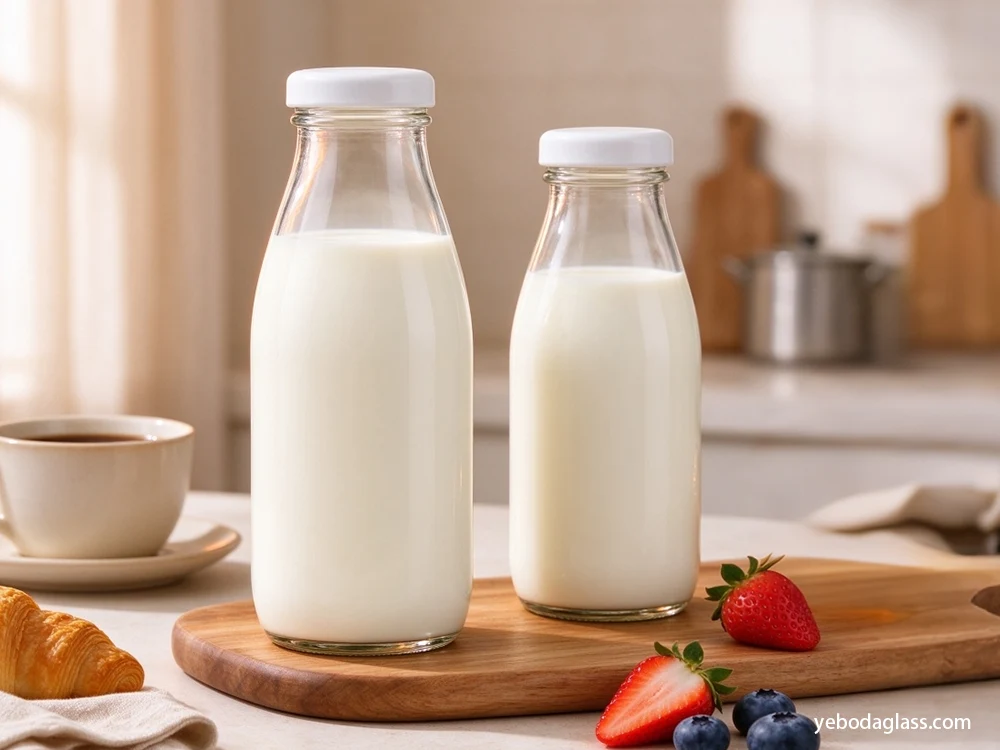
The quality check should not be limited to checking if the bottle is clear.
The risks associated with different defects are different. If the specimen is found to have a small cosmetic mark, or a crack, sharp edge, or a serious defect of the neck, it may be a bottle that cannot be used, depending on the agreed specification.
| Inspection item | What to examine | Why it matters |
| Glass appearance | Cracks, chips, bubbles, stones, inclusions | Product integrity and appearance |
| Bottle dimensions | Height, body diameter, capacity | Filling-line compatibility |
| Nyak kidolgozása | Opening diameter, rim condition, thread or finish | Closure fit and sealing |
| Wall distribution | Uneven glass thickness | Structural consistency |
| Base condition | Flatness, thickness, stability | Standing and handling |
| Annealing quality | Residual stress indicators | Törésveszély |
| Záróelemek kompatibilitása | Cap fit and sealing | Leakage prevention |
| Packaging condition | Cartons, dividers, protective materials | Transportation protection |
An example of application: A dairy firm places an order for 10 000 bottles, each of capacity 500 ml. Even though the bottle bodies seem to be very similar, if this neck finish changes outside of the tolerance, many thousands of closures could be affected.
That’s why customers should always ask for the dimensions, rather than just the capacity.
Standard Glass Milk Bottles B. Reusable Glass Milk Bottles
Bottles don’t need to be the same for all dairy operations. A manufacturer who makes products to supply local restaurants might focus on consistent filling and closing efficiency. Dairy which are utilizing a return and refill system will need to pay greater focus on repeated handling and washing conditions.
| Comparison factor | Standard glass milk bottle | Reusable glass milk bottle |
| Intended use | Depends on product specification; often single-use distribution | Designed for repeated use |
| Wall design | Based on the selected bottle and application | Must account for repeated handling |
| Cleaning | May be cleaned before filling according to process requirements | Requires a validated washing and sanitization process |
| Ellenőrzés | Before filling and during agreed quality checks | Before filling and throughout reuse cycles |
| Durability assessment | Relevant handling and transport conditions | Repeated washing, handling, and distribution |
| Cost considerations | Purchase and packaging cost | Purchase, collection, washing, and replacement costs |
Just because it’s reusable doesn’t mean it’s cheaper. The cost is dependent on the number of successful re-use cycles, collection efficiencies, washing costs, breakage and replacement rates.
Suppose, for example, that the equation represents a linear function.
A dairy buys 5,000 re-useable bottles at $0.80 per bottle. The initial cost of bottles is $4,000. Theoretically, the cost of the bottles used is $0.04 per use (excluding collection, washing, inspection, breakage and logistics) when 20 successful cycles are completed.
This is a planning calculation and NOT an operating cost. Actual results will vary based on the re-use system.
Customized Glass Milk Bottles and Regulatory Compliance
There is no such thing as a marketing terminology for food contact compliance. It is a requirement, which has been documented and needs to be evaluated based on the target market and intended use.
Two important references are for European buyers:
Regulation (EC) No 1935/2004
This provides a general guideline for food contact materials and articles.
Regulation (EC) No 2023/2006
This includes GMP for materials and articles that may contact food including quality assurance and quality control.
Official references:
- EU Regulation (EC) No 1935/2004
- EU Regulation (EC) No 2023/2006
U.S. dairy operations need to also know about the FDA Grade A Pasteurized Milk Ordinance (PMO). It contains clauses pertaining to containers, packaging and the working of the milk plants.
Source: FDA Grade A Pasteurized Milk Ordinance.
The caveat is that even if a supplier states that bottles are “food grade,” they must meet all destination market or intended use food grade requirements. Purchase orders should identify and/or confirm that all aspects of the packaging system meet the customers’ requirements.
How to Spot High-Quality Glass Milk Bottles before Purchasing in Bulk
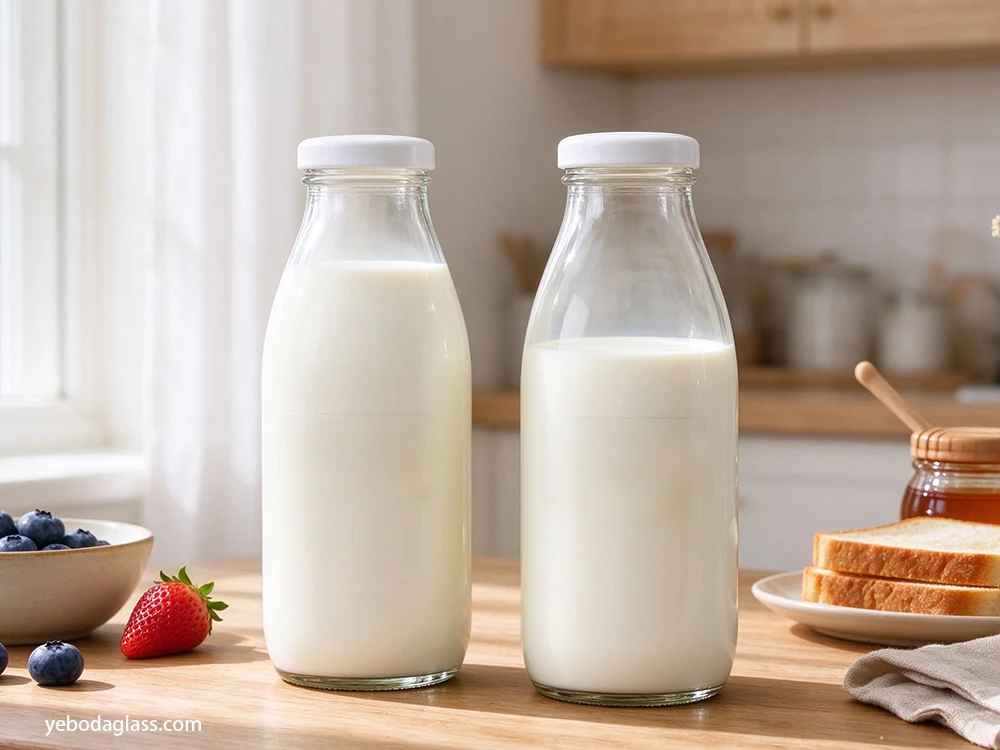
Never agree to mass production without a sample or the actual product or equipment seen in a showroom.
A better way to do this is to draw up a written specification and take production-representative samples.
Use this checklist:
- Check the size and volume of bottles.
- Take measurements for the opening and check the given neck finish.
- Inspect the rim for any chips or irregularities.
- Check for balance at the bottom.
- Compare the appearance of glass from various specimens.
- Test the indicated cap or closure.
- Perform a leak test under specified conditions.
- Wrap up packaging protection review and carton configuration.
- Ask for any appropriate inspection reports.
- Final specification approval prior to bulk production.
If the volumes are larger, buyers may agree to a plan of acceptance sampling. ISO 2859-1 offers sampling methods that are arranged by Acceptance Quality Limit (AQL) for lot-by-lot inspection.
Official reference: ISO 2859-1 – Sampling Procedures for Inspection by Attributes.
AQL is not a standard defect rate for üvegpalackok. Prior to production, the buyer and supplier should agree on the level of inspection, the nature of the defect, the limit for the defect and the rejection procedure.
Packaging and Shipping: Last Quality Control Stage
A bottle is not a successful delivery if it is produced in good condition and then breaks on delivery.
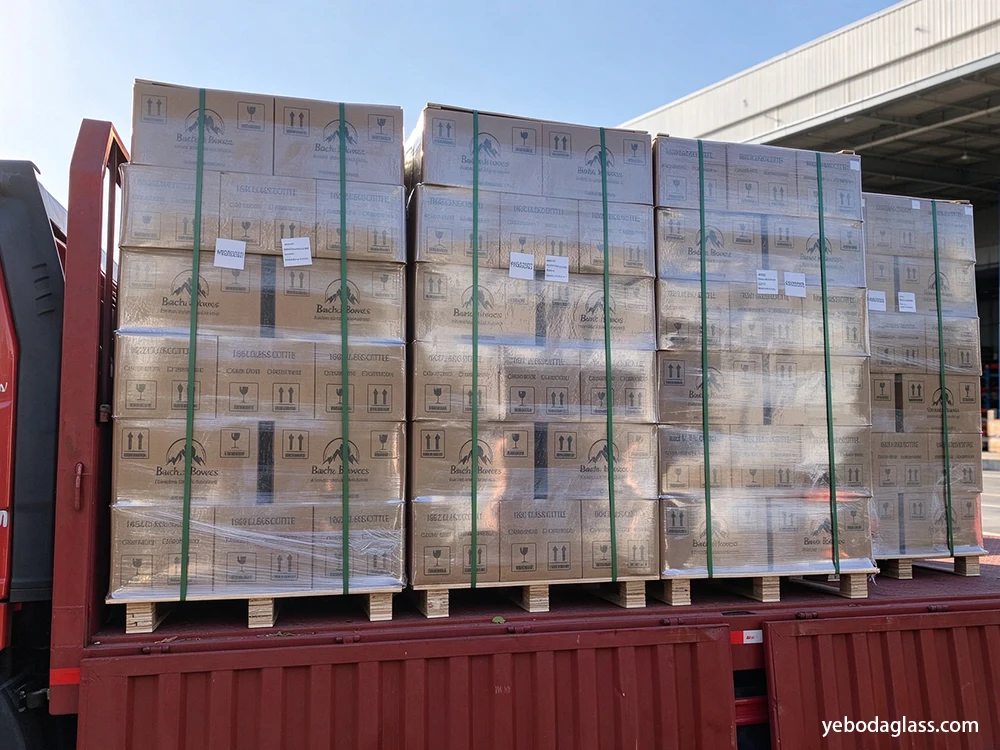
Glass milk bottles must be protected by a proper impact, vibration and bottle-to-bottle protection. Various ways of loading pallets and carton strength as well as internal dividers have an impact on transportation performance.
Suppose we’re going to ship 10,000 bottles.
Five hundredths of 1% equal five hundredths of bottles that are damaged, which is 50. The direct loss of the product is $40 at an illustrative unit price of $0.80. However, the true expense can be significantly greater when considering inspection work time, replacement shipping, production downtime, and administrative time and effort.
However, any buyer should request:
- The dimensions and material properties of cartons.
- The design of an internal divider or separator.
- Pallet loading arrangements.
- Take photos of the containers being loaded, if available.
- Clear reporting process in case of damage to the transit.
The packaging validation is concerned with the procedures employed for testing packaged products in simulated distribution and can be read in the ISTA transport testing procedures.
How to Select the Most Effective Glass Milk Bottle Wholesaler for Dairy Companies
Don’t assume that the lowest quote is the cheapest.
A lower price quoted supplier may be: using a different bottle weight, using less protective packaging, using a different closure specification, using less rigorous inspection. Price comparisons are inaccurate if the specifications are not comparable.
When choosing a bulk glass milk bottle supplier, consider the following questions:
| Supplier evaluation factor | Questions to ask |
| Product specifications | Can you provide technical drawings and dimensional tolerances? |
| Anyagi információk | Can you provide relevant food-contact documentation? |
| Minőségellenőrzés | What defects are checked during production and final inspection? |
| Záróelemek kompatibilitása | Are caps tested with the exact bottle neck finish? |
| Production consistency | How are variations between batches controlled? |
| Csomagolás | How are bottles protected during export transportation? |
| Commercial terms | What are the MOQ, sample charges, and production lead time? |
| After-sales support | How are quality complaints and damaged deliveries handled? |
A serious supplier should have answers to these questions. The lack of measurable specifications and documented procedures is not acceptable when assurances are given as vague as “high quality” or “food grade material” or “strict inspection.”
Gyakran Ismételt Kérdések
What would the glass milk bottle wholesaler do to ensure the quality of bottles?
A glass milk bottle wholesaler ensures the quality of glass bottles that are produced by the control of materials, production monitoring, dimensional inspection, visual inspection, annealing control, closure compatibility inspection and the final inspection of packaging. Consistent suppliers also have agreed specifications and quality records to aid the buyer in ensuring consistency from bulk production lots.
What is the special quality for glass milk bottles to be used to make milk?
Glass milk bottles for food are produced and evaluated for their intended food contact use in accordance with the relevant regulatory requirements. Buyers are recommended to check material data, compliance documents, and the suitability of the entire packaging system, including closures, coatings, and decorations (if applicable).
What are the common defects for the glass bottle inspection?
Purchasing buyers should look for cracks, chips, sharp edges, large, unacceptable bubbles, foreign inclusions, size irregularities, neck irregularities and bases that are unstable. The classification of defects should be based on their safety and functional consequences and should be negotiated with the wholesaler and buyer before the production starts.
What is a way to test the strength of the glass milk bottle?
The strength of a glass milk bottle can be tested by appropriate tests according to the bottle design and its use, such as impact resistance test, thermal shock test, and other tests. Where possible, the buyer must ask the supplier about the methods used and the results obtained for testing the product and agree to the acceptance criteria, not on its appearance.
Are glass milk bottles better than plastic?
Re-usable glass milk bottles are made to be used again and again for the purpose of cleaning up, but they are not necessarily as strong as all of the bottles. They are not suitable for all designs, manufacturing, washing conditions, handling procedures, or number of validated reuses by the dairy operation.
What is the list of papers I need to be requesting from the glass milk bottle wholesaler?
All technical drawings, product specifications, food contact compliance, inspection records (if available), closure information and packaging information is requested. Reusable bottles must also inquire about bottle cleaning conditions and durability and/or re-use testing on the bottle.
How to minimize breakage during transport of milk bottles in glass containers?
Combining the right bottle specifications, protective internal dividers, the right-sized cartons, pallet stacking and loading the right way is the best way to reduce transportation breakage. The entire package configuration should be checked by the buyer with the shipping line and handling terms.
Make Quality Your First Purchasing Requirement
The selection of a glass milk bottle wholesaler should not start with the claims of promotion, but from the specifications.
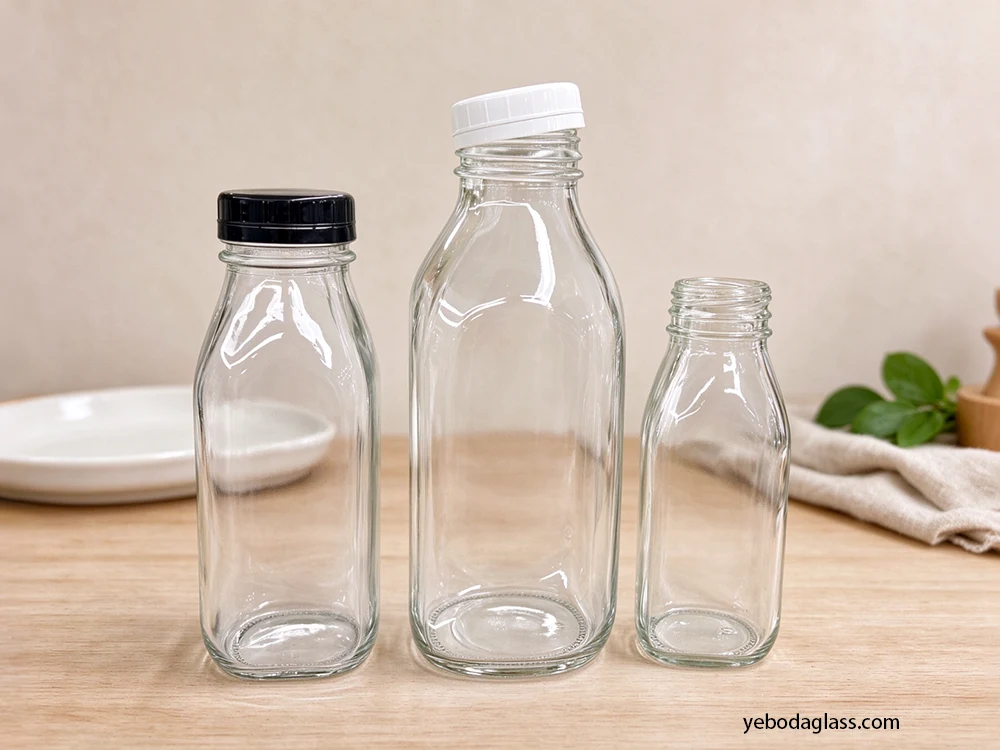
Define glass type, glass size, glass neck finish, end of glass compatibility, inspection criteria and package. Approve production-representative samples. Have the acceptable quality limits written in a document.
Then compare quotations.
A reputable wholesale glass milk bottle supplier will be able to give you information on what they have to offer, but also how each glass milk bottle is made to ensure that you can expect each one to be the same.
Looking for a bulk glass milk bottle supplier for your dairy business? Give your specifications for capacity, bottle design, order quantity, closure and target market for sample and technical specification and a detailed wholesale quote.
 HU
 EN
 FR
 DE
 IT
 ES
 CS
 PT
 NL
 PL
 TR
 AR
 KO
 JA
 ZH
 RU