
Introduction
A yogurt jar looks simple.
It isn’t.
If the wrong glass yogurt jar vendor is used, then the problems may show up after the product has started to be produced: Problems with neck dimensions, failures to fit lids on the jars, breakage during the filling process, defect in decorations, higher freight costs, or documentation that doesn’t meet the food-contact requirement of a target market.
I have encountered the same situation with buyers over and over. They ask about the unit price first and they would research the supplier second.
That order is backwards.
A commercial buyer should evaluate the jar as part of a packaging system—glass body, closure, filling line, labeling, palletization, transportation, storage, and final retail handling—not as an isolated piece of glass.
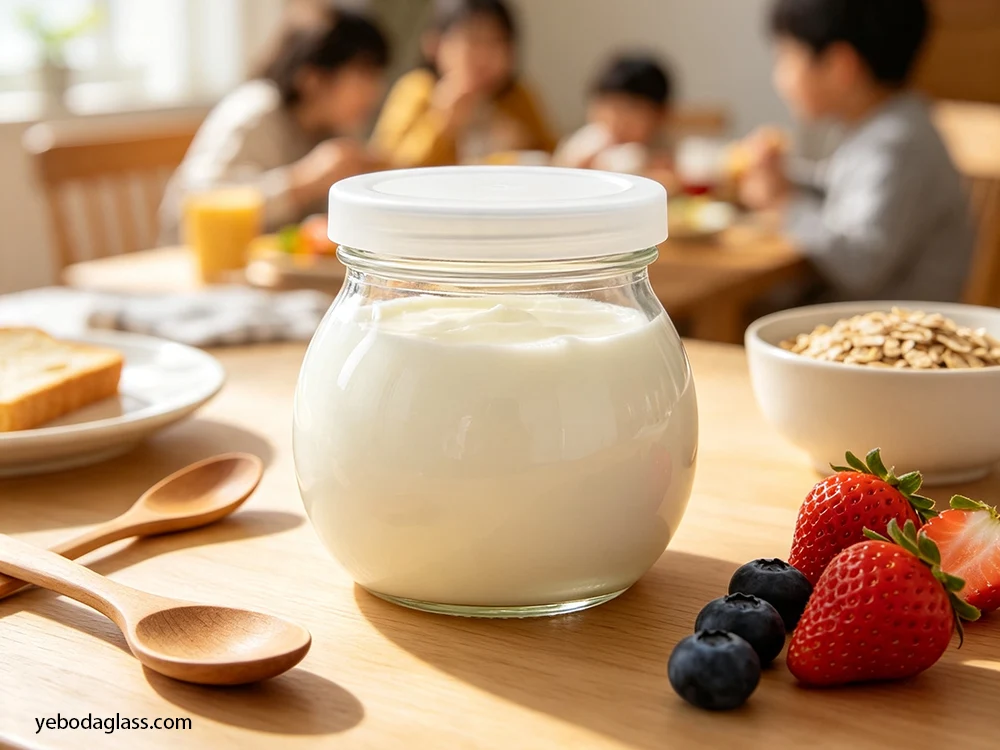
Start With the Actual Packaging Requirement
Before contacting a glass yogurt jar supplier, define the application.
A 100 g container of Greek yogurt in a refrigerated supermarket does not need to have the same specification as a 500 g package of premium Greek yogurt in a specialty retailer. The specification can be influenced by the filling temperature, the cooling process, the closure, the shelf-life, handling and the visual positioning.
At least provide the following information:
- Target capacity, such as 100 ml, 150 ml, 200 ml, 250 ml, or 500 ml
- Nominal fill volume and brimful capacity
- Jar diameter and overall height
- Neck finish and closure type
- Glass color and transparency
- Required wall and base strength
- Filling and capping process
- Decoration requirements
- Expected annual volume
- Target market and food-contact regulations
- Pallet and carton requirements
- Required delivery schedule
This specification sheet immediately separates serious suppliers from traders who simply forward a catalog.
And that distinction matters.
A capable custom glass yogurt jar manufacturer should be able to discuss tolerances, mold development, closure compatibility, inspection procedures, and packaging configuration—not just send you ten attractive product photographs.
Food-Contact Compliance Comes Before Decoration
For yogurt packaging, food-contact safety is not a marketing phrase.
It is a procurement requirement.
The European Commission states that food-contact materials—including glass, plastic, paper, and metal—must comply with EU food-contact rules. Regulation (EC) No. 1935/2004 establishes general requirements intended to prevent materials from transferring substances into food at harmful levels or causing unacceptable changes in food composition, taste, or odor.
European Commission — Food Contact Materials
So when evaluating a vendor, don’t ask only:
“Is this glass food grade?”
Ask for documentation.
The documentation required may include information on glass composition, food contact suitability, manufacturing controls, migration or relevant safety testing, traceability, and closure.
The packaging system can be glass, but it can also consist of plastic lids, plastic liners, coatings, inks, adhesives, and more.
This is where untrained buyers make their mistakes.
Glass Quality Is More Than “Thick or Thin”
A common purchasing shortcut is to assume that thicker glass automatically means better glass.
Not necessarily.
What matters commercially is whether the container performs consistently under the actual production and distribution conditions.
A supplier should be able to discuss:
- Dimensional tolerances
- Wall-thickness consistency
- Base thickness
- Finish dimensions
- Vertical load performance
- Thermal shock resistance where relevant
- Internal stress and annealing
- Surface defects
- Inclusions
- Cracks and checks
- Chips around the finish
- Color consistency
- Weight variation
For a yogurt producer, dimensional consistency can be particularly important because a jar that is technically usable may still cause trouble when automated equipment handles thousands of units per hour.
The closure is another weak point.
A jar with a beautiful body but inconsistent finish dimensions is a bad packaging solution.
Ask How the Vendor Controls the Mold
This is one of the questions I would ask before discussing price.
Who owns the mold, who maintains it, and how are dimensional changes controlled?
For custom jars, mold management can affect long-term consistency. A supplier should be able to explain the mold-development process, trial sampling, dimensional approval, maintenance schedule, and what happens when the mold reaches a certain production life.
For brands ordering repeatedly, this becomes even more important.
You don’t want Batch 1 and Batch 8 to look like they came from different factories.
A reliable vendor should retain approved specifications and reference samples so that future production can be checked against an established standard.
Customization: Don't Confuse Decoration With Custom Packaging
There are two very different levels of customization.
Decoration customization changes the appearance of an existing jar. This may include:
- Screen printing
- Frosting
- Coating
- Label application
- Embossing
- Debossing
- Color effects
- Printed logos
Structural customization changes the container itself:
- New jar geometry
- Custom shoulder
- Custom base
- Modified neck
- Custom embossing
- Special closure interface
- New mold
For a yogurt brand trying to create a distinctive shelf presence, structural customization can produce a stronger visual identity—but it also introduces tooling costs, development time, sampling requirements, and minimum order considerations.
This is where a glass yogurt jar vendor should provide numbers rather than vague promises.
Ask for:
- Mold/tooling cost
- Prototype or trial quantity
- Sample lead time
- Mass-production lead time
- Minimum order quantity
- Decoration MOQ
- Replacement policy for defective goods
- Mold ownership terms
- Storage or maintenance terms
- Price difference between standard and custom designs
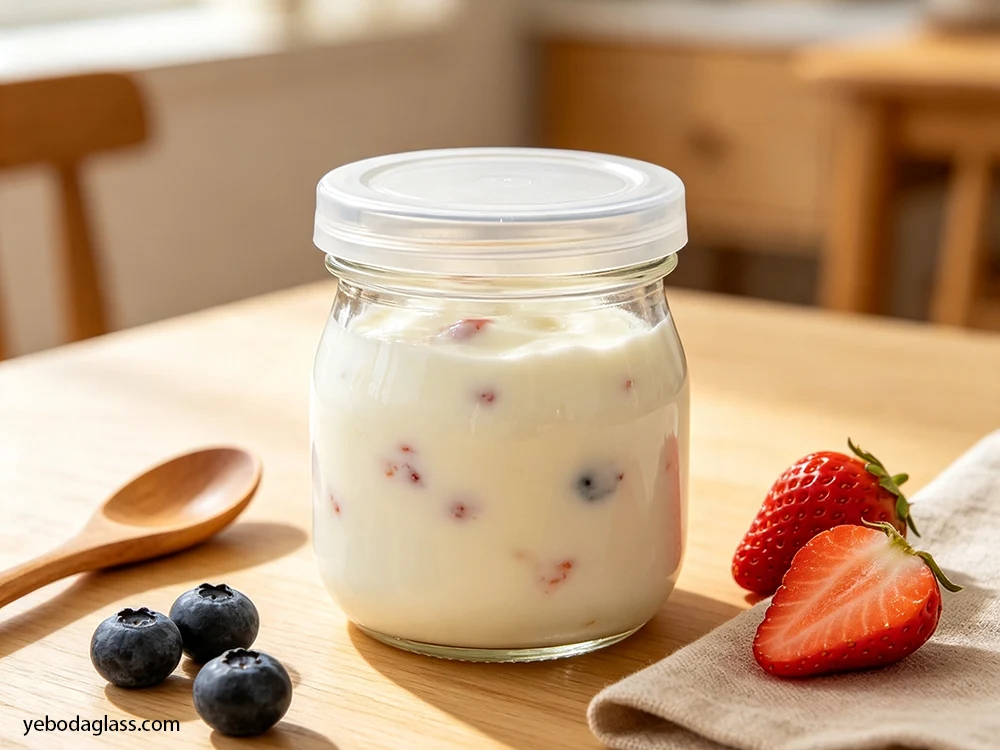
Freight Can Destroy a “Cheap” Jar
Here’s the uncomfortable part.
A supplier offering a jar at $0.18 may be more expensive than one offering $0.21 if the cheaper supplier uses inefficient pallet configurations, has a higher breakage rate, or requires additional protective packaging.
For wholesale purchasing, evaluate landed cost, not simply factory price.
| Cost Factor | What to Check | Why It Matters |
| Unit price | Price per jar at target volume | Basic purchasing cost |
| Mold cost | One-time tooling fee | Important for custom jars |
| Closure | Lid + liner + sealing components | Complete packaging cost |
| Packaging | Carton, divider, pallet | Affects protection and freight |
| Loading efficiency | Jars per carton/pallet/container | Direct logistics impact |
| Breakage | Damage rate during transit | Hidden replacement cost |
| Lead time | Production + shipping | Affects inventory planning |
| MOQ | Standard and custom MOQ | Determines cash commitment |
| Quality control | Inspection and defect handling | Reduces production risk |
| Documentation | Food-contact and traceability files | Supports market compliance |
For a high-volume yogurt brand, even a $0.01 difference per jar becomes $10,000 across 1 million units.
That’s why procurement should calculate the entire supply equation.
Sustainability Needs Numbers Too
“Sustainable glass” is becoming an overused sales phrase.
Explain what it means.
While glass has very good recycling qualities, the environmental performance of a pack format is dependent on the recycled content, reuse systems, transport distance, manufacturing energy, recycling infrastructure and pack weight.
In the 2024 Singapore government response, it was stated that the recycling rate for glass in 2022 was 14% while there was a need to consider a broader producer-responsibility solution as glass is relatively expensive for recycling.
Singapore Ministry of Sustainability and the Environment — Glass Recycling
So if a vendor claims that a jar is “100% sustainable,” ask for measurable information:
- Recycled glass content
- Jar weight
- Recyclability
- Packaging-to-product ratio
- Pallet efficiency
- Transport distance
- Reusable packaging options
- Relevant environmental documentation
The claim should survive a spreadsheet.
What a Serious Vendor Should Show You
When I evaluate a supplier, I don’t want a beautiful website first. I want evidence.
A credible glass yogurt jar vendor should be able to provide a combination of:
- Factory information
- Product drawings
- Technical specifications
- Material information
- Food-contact documentation
- Quality-control procedures
- Sample approval process
- Mold-development process
- Production capacity
- MOQ information
- Packaging specifications
- Inspection records
- Shipping arrangements
- Defect and replacement procedures
And I would ask for actual samples.
Not photographs.
Samples.
Physical glass tells you things a product page cannot: seam visibility, finish quality, base stability, wall consistency, clarity, weight, closure fit, and overall handling.
Compare Vendors Before You Compare Prices
A useful procurement scorecard could look like this:
| Evaluation Area | Standard Supplier | Capable Custom Vendor | Strong Long-Term Partner |
| Product range | High | High | High |
| Custom mold capability | Low | High | High |
| Food-contact documentation | Basic | Detailed | Detailed |
| Dimensional QC | Basic | Strong | Strong |
| Closure matching | Limited | Strong | Strong |
| Decoration | Limited | Multiple options | Multiple options |
| MOQ flexibility | Medium | Medium | High |
| Bulk capacity | Medium | High | High |
| Supply planning | Basic | Good | Strong |
| Traceability | Limited | Good | Strong |
| Defect management | Basic | Documented | Documented + corrective action |
| Long-term consistency | Uncertain | Good | High |
This is where the best glass yogurt jar vendor for brands usually separates itself from the cheapest quotation.
Price still matters.
It just shouldn’t be the first filter.
The Hidden Question: Can They Scale?
A supplier may handle 20,000 jars without difficulty and struggle badly at 500,000.
Ask about production capacity at your expected annual volume.
For example, if your yogurt business needs 100,000 jars per month, the vendor should be able to explain:
- Monthly production capacity
- Current capacity utilization
- Planned maintenance
- Production scheduling
- Raw-material availability
- Mold availability
- Backup production arrangements
- Peak-season capacity
- Container-loading capacity
A factory with 10 million units of theoretical annual capacity is not necessarily a supplier with 10 million units of available capacity.
That’s an important distinction.
What About Sustainability and Consumer Perception?
Glass yogurt packaging can also create a strong premium positioning.
A recent study examining yogurt packaging found that glass jars represented a minority of the yogurt packaging samples analyzed, while the study reported approximately 99% recyclability for the glass jars it assessed.
Technical Recyclability and Carbon Footprint of Packaging for Butter, Yogurt, and Spreads
But don’t turn that finding into a blanket claim that every glass yogurt jar has a 99% recycling rate in every market. Packaging recycling performance depends heavily on local collection and processing systems.
In the case of B2B customers, that is not something that matters when writing those sustainability claims.
FAQs
What are the qualities of a good glass yogurt jar merchant?
A glass yogurt jar vendor needs to prove food contact suitability, dimensional consistency, reliable closure compatibility, quality control procedures, production capacity, transparent MOQ & tooling terms and reliable bulk delivery. For custom projects, the vendor should also offer technical drawings, mold-development support, and samples as appropriate, inspection standards, and documentation for the intended market.
Can glass yoghurt containers be used in dairy industry packaging?
Glass yogurt containers can be used for commercial dairy packaging provided that the container, closure, manufacturing process and end uses are correctly specified and validated. As many people do not realize, some glass jars are not food-contact compatible, are not thermally or mechanically resistant, are not compatible with certain closures, or may need special hygiene controls, and can have handling requirements.Food-contact compatibility, thermal and mechanical resistance, closure compatibility, hygiene control and handling requirements are all things that must be verified before buying, not assumed.
What quantity of glass yogurt jar should I buy from the supplier?
The correct quantity required is dependent on annual demand, inventory strategy, MOQ, production capacity, shelf life, storage space and transportation economics. If the buyer is using the product in a business, it is generally easier to calculate the demand in terms of number of units or frequencies (annually or quarterly) and then select the appropriate supplier, rather than just taking the supplier’s minimum order, since small lots can cost more per unit and for freight.
What are the standards to look for in yoghurt jars?
The food-contact standards are determined by the end-use application market and the entire packaging system – the glass jar, closure, liner, coatings, inks and adhesives. The general principles of the Regulation (EC) No. 1935/2004 for the EU are that food-contact materials should not migrate into food in harmful amounts or result in unacceptable alterations to the food.
Which would you prefer to buy: a standard jar or a custom yogurt jar?
Generally, a standard jar is better in terms of speed, tooling cost, and production efficiency but when brand differentiation, unique geometry, embossed or proprietary dimensions are more important, a custom jar may be more appealing because it is more expensive and time consuming to develop. Considerations should include long-term packaging strategy, shelf impact, tooling amortization, and expected volume.
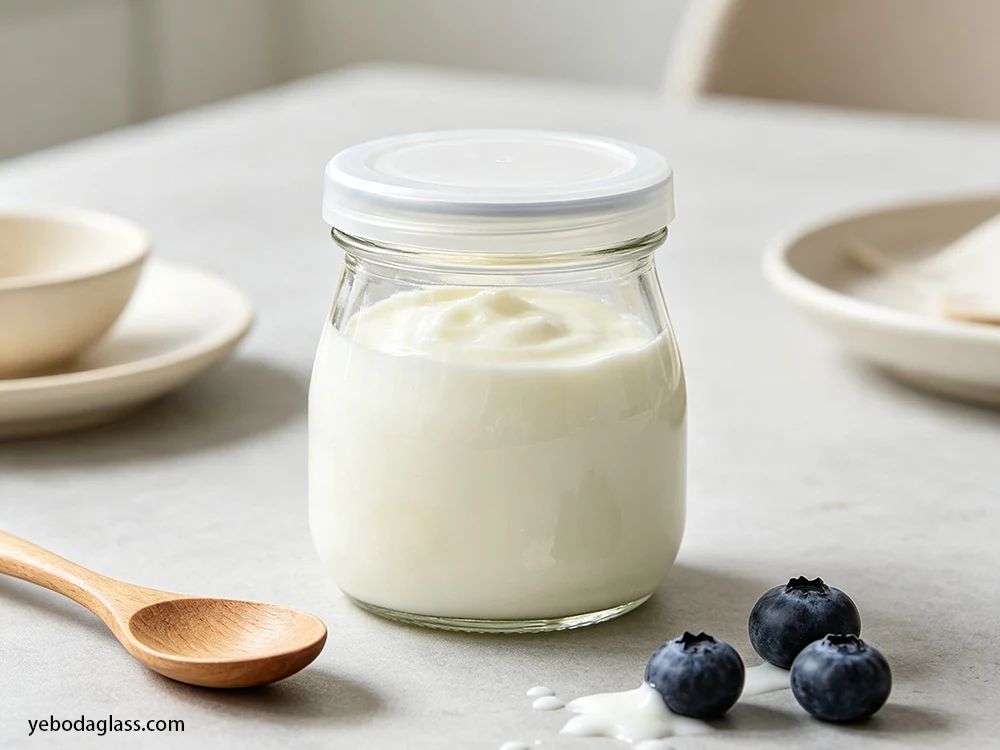
Select the Vendor That Can Prove It
Cheap quotation is easily found.
The hard-to-find supplier is the one who can keep the same jar specification on repeat production runs, can offer the proper food contact documentation, has the proper arrangements for closing, is able to control the defects, guard the shipment, and scale as your business grows without turning every order into a negotiation.
It would be the standard that I would use.
For bulk orders of glass yogurt jars, your requirements are the capacity, dimensions, closure type, annual requirement, decoration specifications, and destination market of the glass yogurt jars you are buying for your bulk order. Then compare quotations on the full technical and supply package and not just the price on page one.

 EN
EN  FR
FR  DE
DE  IT
IT  ES
ES  CS
CS  PT
PT  NL
NL  PL
PL  TR
TR  AR
AR  KO
KO  JA
JA  ZH
ZH  RU
RU  HU
HU