
Einleitung
A honey pot isn’t a pot.
For many customers, it is the first physical quality indicator they see before opening the lid of the container. That makes it more difficult for food brands, distributors and private label honey companies to choose between a few quotations when it comes to selecting a honey jar exporter.
The cheap jar can become expensive.
Breakage. Poor sealing. Inconsistent neck dimensions. Decoration that scratches during transport. A custom mold that looks excellent in CAD but performs badly on the filling line.
I have seen this pattern repeatedly in packaging procurement: buyers focus on the glass price first and discover the real cost later.
Das ist falsch herum.
For a serious honey brand, the better question is not “Who sells the cheapest jar?” It is “Which exporter can manufacture the required shape, maintain dimensional consistency, match the closure, document food-contact suitability, and repeat the same result six months later?”
That is where custom honey jar exporters become strategically important.
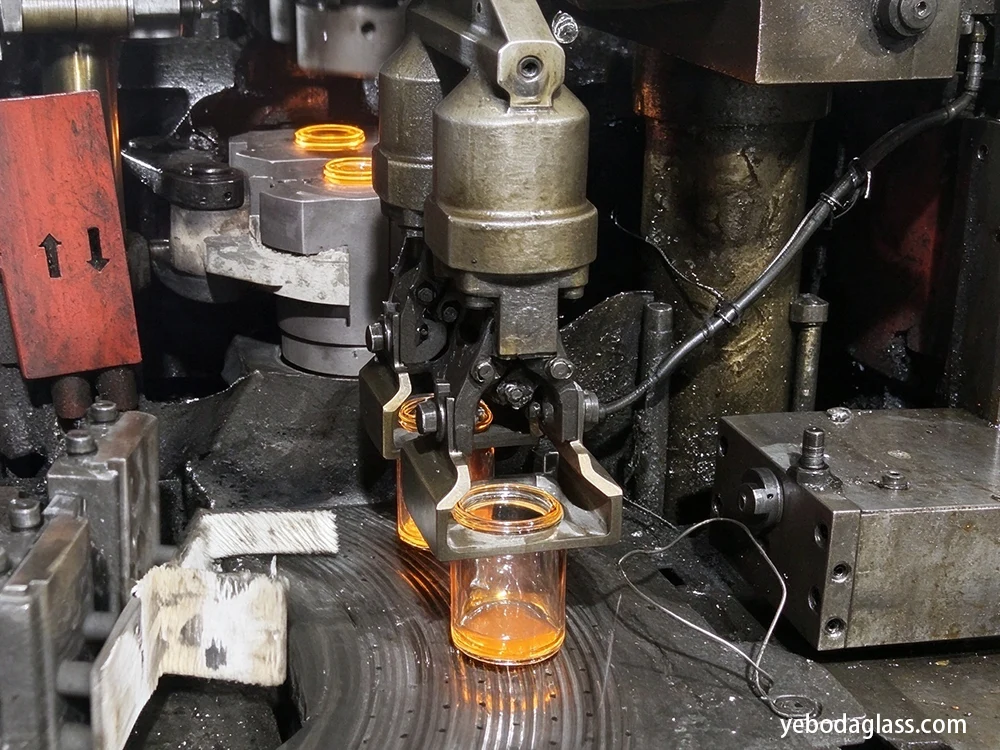
Why Custom Glass Honey Jars Are Becoming a Procurement Issue
Standard round jars are easy to source. They are also easy to forget.
Honey products can be spotted by a clear hexagonal outline. They also show a queenline shape, plus a raised shoulder. Many have a thicker bottom. Some come with odd sizes, and some use a special kind of cap. Glass packaging trends right now point the same way. People want bottles with custom shapes. They also like embossed details. Firms are pushing lightweight versions too. That cuts the amount of material used. It can also lower shipping costs.
But customization creates engineering consequences.
Change the shoulder angle and you may change stress distribution. Change the neck finish and the existing cap may no longer fit. Increase the embossing depth and cleaning or demolding requirements can change. Make the base heavier and shipping weight rises.
Small change. Large consequence.
For that reason, professional honey jar exporters and suppliers should be evaluated on the complete packaging system rather than the glass body alone.
What Can Be Customized in OEM Honey Jar Manufacturing?
A capable supplier should be able to discuss customization at several levels.
The first is called geometry. Round, square, hexagonal, queenline or any completely proprietary profile may be requested by the buyer.
The second is capacity. Common commercial sizes are from small gift jars to larger family size jars, but actual size will depend on filling equipment, viscosity of the honey, label size, shelf placement, and target market.
The third one is the neck and closure.
Honey is viscous. That matters.
A small opening can be difficult to fill, and can cause a mess when dispensing. Sealing can be affected by an improper liner fit. Attractive samples can turn into an ongoing problem if the torque and fit are not consistent during mass production.
The fourth one is decoration.
Logos can be embossed, labels can be done with screen printing, labels can be frosted, coated, hot stamped or tinted with color to differentiate. But each introduces another production variable that must be looked at.
The current offerings of suppliers illustrate the range of this customization stack: shape, size, color, logo, packaging, and decoration are all examples of specifications that can be made for a custom glass jar project.
Comparison: Stock vs Custom Honey Jars
| Factor | Stock Honey Jar | Custom Glass Honey Jar |
| Form | Existing standard shapes | Proprietary or modified shapes |
| Mold | Usually no new mold | New or dedicated mold may be required |
| Mindestbestellmenge | Often lower | Usually higher |
| Stückkosten | Lower initially | Higher during development |
| Markendifferenzierung | Beschränkt | Stark |
| Logo | Label or printing | Embossing, printing, labeling and more |
| Kapazität | Fixed options | Can be developed to specification |
| Schließung | Existing compatible options | Closure can be matched and validated |
| Development Time | Shorter | Sampling and approval required |
| Am besten für | Commodity or test orders | Established brands and private label products |
The important point is simple: custom does not automatically mean better.
Custom means more control.
Whether that control creates value depends on the brand, order volume, shelf strategy, and expected product life.
The Hidden Cost of Choosing the Wrong Honey Jar Exporter
Here is the uncomfortable part.
A supplier can quote a jar at $0.20 less and still cost your company more.
Suppose a buyer orders 50,000 jars. A $0.20 difference appears to save $10,000. But if 2% of the shipment arrives damaged, that represents 1,000 units before considering replacement freight, repacking labor, customer complaints, or lost sales.
The arithmetic changes quickly.
And breakage is not the only issue.
For export orders, procurement teams should examine:
- glass weight and dimensional tolerance
- base and wall consistency
- neck finish tolerance
- closure compatibility
- sealing performance
- decoration adhesion
- carton and divider design
- Palettenkonfiguration
- loading efficiency
- inspection procedures
- replacement policy
- production traceability
Hence, it is always best to get the best honey jar exporter for food brands rather than the one offering the lowest price.
It is the supplier that is responsible for the variables that define the downstream cost.
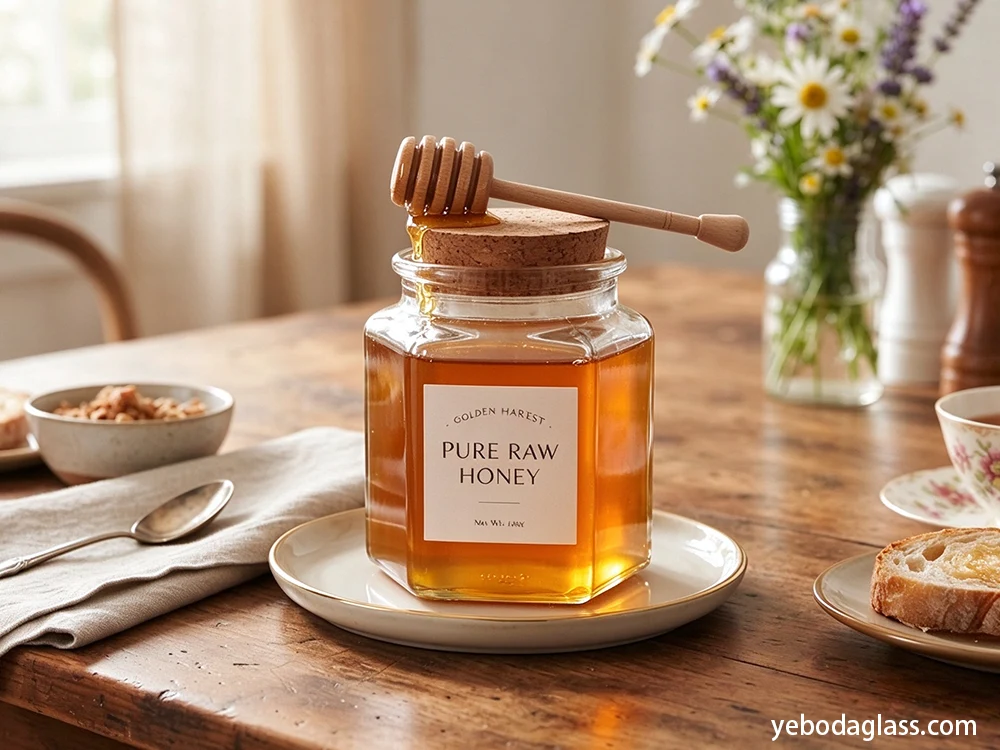
Food Contact Compliance Cannot Be Treated as a Marketing Phrase
The term “food grade” is reassuring.
It is not a sufficient remedy.
According to U.S. FDA, food-contact materials are assessed based on the regulatory status of the substances that form the material and the intended use of the material. The guidance also identifies food types and conditions (room-temperature storage, refrigerated storage, hot filling, pasteurization, and others).
For honey packaging, buyers should therefore ask for documentation appropriate to the destination market and intended use rather than accepting a generic “FDA approved” statement.
That distinction matters.
A procurement specification should include the following information: Food product, contact conditions, closure components, coatings or decoration which may come into contact with the product and the relevant regulatory framework.
That is, compliance must be recorded on a component basis.
No brochure printing.
How to Customize Glass Honey Jars Without Creating Unnecessary Risk
Staged development is typically the safest way to go.
Begin with the demand of the business.
Identify capacity, dimensions, filling process, closure, label space, annual volume, destination market and retail orientation.
Then assess the current molds.
This step is often forgotten. When an existing mold is close to the desired shape, modifications of an available mold could save in tooling costs and development time. When the brand requires a truly proprietary silhouette, it’s more of a sensible approach to have a dedicated mold.
Next comes sampling.
Do not approve a beautiful empty jar and assume the project is finished.
Fill it.
Cap it.
Label it.
Stack it.
Transport it.
Then inspect it again.
That is the difference between packaging design and packaging engineering.
Typical Customization Decision Matrix
| Buyer Requirement | Recommended Approach | Main Risk to Check |
| Low-volume market test | Stock jar + custom label | MOQ and unit economics |
| Premium honey brand | Custom shape + embossing | Tooling and dimensional repeatability |
| Large-volume private label | Existing mold + decoration | Versorgungssicherheit |
| Gift honey set | Custom jar + wood/cork lid | Verschlusskompatibilität |
| Export to multiple markets | Standardized body + market-specific decoration | Regulatory documentation |
| Strong shelf differentiation | Proprietary shape | Mold cost and production stability |
| Cost-sensitive wholesale | Existing stock shape | Limited differentiation |
| Long-term flagship product | Dedicated mold | Tool ownership and repeat production |
What a Professional Honey Jar Exporter Should Tell You Before Quotation
A quotation without technical assumptions is almost meaningless.
Inquire from the supplier about the material of the glass, capacity, dimension, neck finish, closure specification, MOQ, sample policy, mold cost, production lead time, packing method, inspection standard, and Exports terms etc.
For instance, one current supplier of honeys in jars offers publicly a stock MOQ of 5,000 pieces, and a second supplier of honeys in the custom hexagonal format offers a typical lead time of 25-35 days from sample and artwork approval. The following are supplier-specific and should not be regarded as standard industry prices, but do reflect the point of why buyers must consider specification as well as unit price.
And MOQ may change quite a bit.
There are some big manufacturing companies who make MOQs to the public of 300,000 pieces for some of their honey-jar programs.
It’s this difference that makes the difference between a suitable supplier for a start up honey brand, a regional distributor, or a multinational food company.
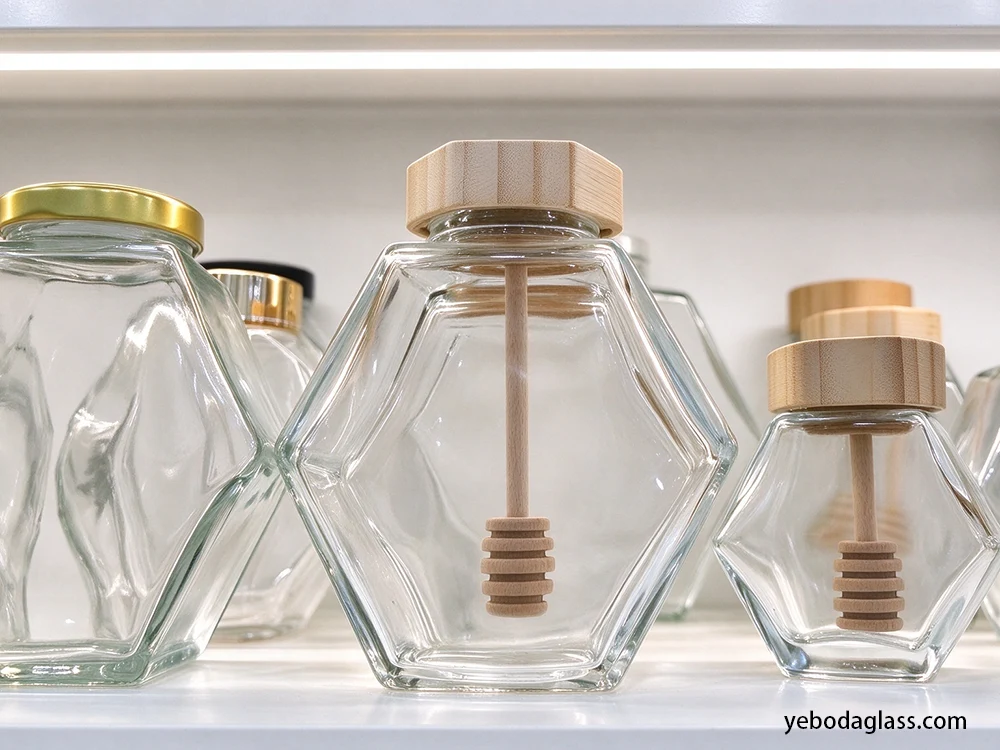
Export Packaging Matters More than Many Buyers Expect
The jar may come out of the kiln still pristine, but end up broken.
Why?
Packaging density, separators, carton compression, movement of pallets, loading of containers, humidity, handling and vibration on the road all play a role.
Whenever export glass Honiggläser are ordered as products, the packaging should therefore be considered as part of the product specification.
Bitten Sie um:
Size of carton and carton count.
Divider or separator configuration.
Pallet quantity.
Container loading estimate.
Drop or compression testing where appropriate.
Photo evidence of finished export packing.
Replacement terms for confirmed transport damage.
A supplier that cannot explain how the finished jars will be protected during a long international shipment is not giving you a complete export solution.
Sustainability Is Now Part of the Commercial Calculation
While glass is obviously recyclable, the lack of packaging redesign is no barrier to recycling glass.
Lightweighting can decrease material consumption and shipping weight and recycled glass can decrease virgin raw material requirements. Lightweight glass and increased recycling of glass are big packaging trends according to industry packaging guidance.
This is the direction that Europe is going.
Regulation (EU) 2025/40 on packaging and packaging waste will be entered into force on 11th February 2025 and will apply from 12th August 2026. The regulation provides a wider context for packaging recyclability and design-for-recycling, and includes specific future targets starting in 2030 and 2035.
This is NOT a theoretical problem for exporters whose customers are in the European market.
Today’s packaging specifications can be in production for years.
This implies that the design of product, material efficiency, decoration, closure parts and documentation must be taken into consideration during the design stage, and not after the jar has gone to market.
How to Choose the Best Honey Jar Exporter
I would score suppliers in five areas.
Product engineering. Can they actually develop a custom shape rather than merely decorate an existing jar?
Quality control. Do they measure dimensions, capacity, weight, appearance, closure fit, and decoration consistency?
Food-contact documentation. Can they explain the regulatory basis for the material and intended use?
Export capability. Can they provide realistic carton, pallet, loading, and shipping information?
Repeatability. Can the second production run match the approved sample?
That final point is underrated.
One perfect sample proves almost nothing.
Repeatability proves manufacturing competence.
Häufig gestellte Fragen
Who is the honey jar exporter?
A honey jar exporter is a manufacturer or supplier of glass honey jars, as well as managing the export of documentation, packing, and shipping honey brands, wholesalers or distributors, or food companies. They can also offer custom shapes, closures, decoration, sampling, quality inspection and OEM development if the exporter is capable.
Are there any opportunities to make a glass honey jar?
Yes, it is possible to design and customise your glass honey jars to be shaped, volume, colour, embossed, decorated, closed, packaged etc. depending on the design, tooling and the minimum order quantity (MOQ). The business is most lucrative when the brand has enough orders to warrant development and long-term production of custom shapes.
What questions should be asked to honey jar exporters?
Honey jar exporters should be asked for minimum order quantity, mold charges, mold dimensions, capacity tolerance, glass specifications, neck finish, closure compatibility, food contact documentation, sample approval, production lead time, inspection procedures, packing for export and shipping terms and replacement policy. These details give much more information about the supplier’s ability than a unit-price quotation.
Is it costly to manufacture honey jars for OEM?
OEM honey jar manufacturing may incur higher upfront costs due to the requirements for creating custom molds, conducting sampling, engineering, decorating and testing. However, for larger, regular orders, a proprietary jar can help differentiate the brand and may be worth the extra investment due to the improved shelf recognition and consistency across time.
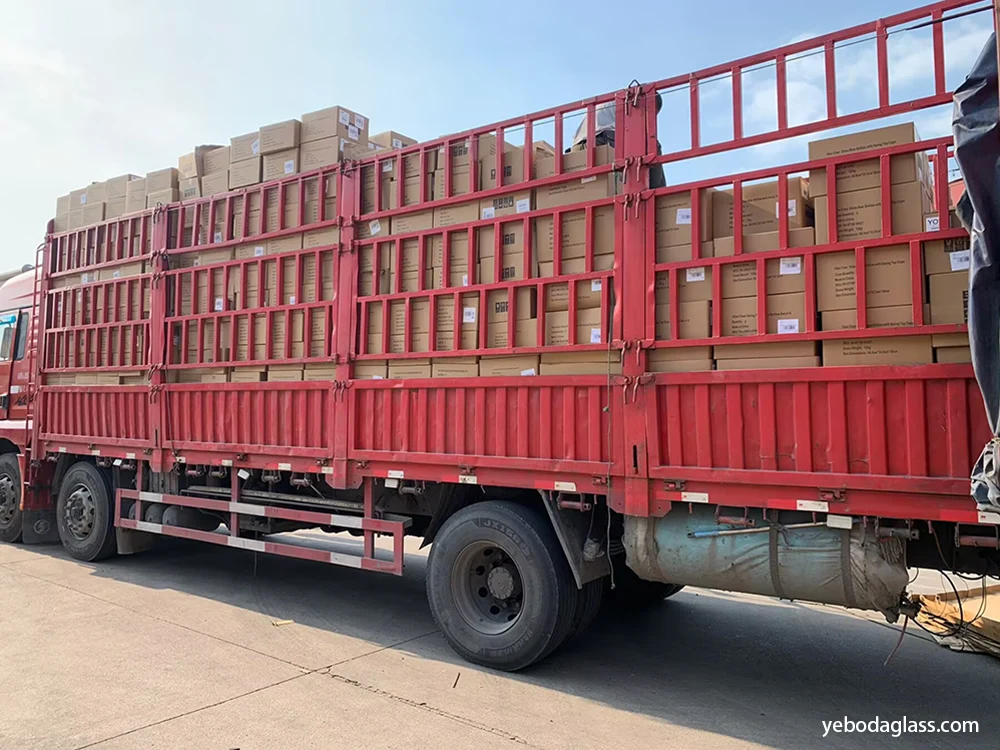
What is the shape of the best honey jar?
While there may be no rectangle that is best for all honeys, the appropriate shape is determined by a variety of factors: filling equipment, the flow of honey, the closure needed, aesthetics, shipping and positioning the brand. The round, hexagonal, queenline, and proprietary shapes can all be suitable provided the geometry and type of closure is designed appropriately.
The Bottom Line
Do not buy the jar.
Buy the system.
The right honey exporter to the right honey jar should be able to blend the shape, glass weight, neck finish, closure, decoration, food contact requirements, inspection, export packing and repeat production into one controlled process.
That’s what makes a trading quotation different to a real packaging solution.
If your brand is looking at creating custom glass honey jars, the next step is simple: Decide on the capacity, the amount of jars your brand requires each year, the shape, the caps or lids, the design and art work, and your destination market, and then your brand should send a technical quotation and request a sample plan from qualified honey jar exporters and suppliers.
A good jar will keep the honey protected.
A well-engineered jar protects the business.
 DE
DE  EN
EN  FR
FR  IT
IT  ES
ES  CS
CS  PT
PT  NL
NL  PL
PL  TR
TR  AR
AR  KO
KO  JA
JA  ZH
ZH  RU
RU  HU
HU