
Three words first.
It depends.
I’ve sat in on factory inspection rooms where buyers rejected whole 200,000-piece honey jar batches because inspectors spotted those tiny bubble s scattered across the sidewalls. The supplier insisted the jars were still within international quality benchmarks. The buyer said the products were defective, plainly. Both camps just kept saying they were right, even when it got tense.
So, who actually was?
The answer is a bit more tangled than most packaging websites will ever admit.
In commercial glass manufacturing, not every thing you can visibly notice gets filed as a defect.
And that is where the confusion really starts.
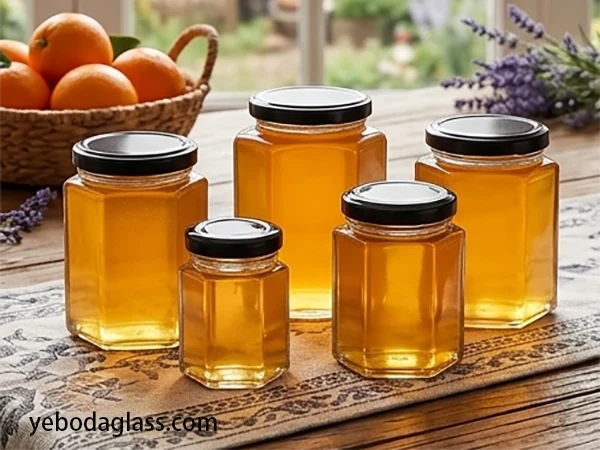
The Hidden Truth About Glass Honey Jar Bubbles Defects
Most first-time importers see a bubble and immediately assume poor quality.
Reasonable assumption.
Often wrong.
In industrial glass manufacturing, small bubbles are commonly called “seeds.”
Not all seeds indicate structural failure.
Not all seeds require rejection.
And some seeds are completely acceptable under commercial packaging standards.
The real question isn’t whether bubbles exist.
The real question is:
- How large are they?
- How many exist?
- Where are they located?
- Do they affect structural integrity?
- Do they affect product appearance?
Without those answers, a bubble means almost nothing.
What Causes Tiny Bubbles in 玻璃蜂蜜罐?
Glass manufacturing looks simple from the outside.
Melt sand.
Form 玻璃罐.
Ship products.
Reality is different.
Modern container glass is typically produced using silica (SiO₂), soda ash (Na₂CO₃), limestone (CaCO₃), and recycled cullet. During melting, gases become trapped inside the molten glass.
Some escape.
Some don’t.
Those trapped gas pockets become visible as seeds or bubbles after the container is formed.
Common causes include:
- Incomplete refining during melting
- Excess recycled glass contamination
- Furnace temperature fluctuations
- Trapped gases during forming
- Raw material inconsistencies
- Excessive production speeds
I’ve visited factories producing over 1.5 million containers per day.
Even highly automated production lines occasionally produce seed bubbles.
The difference lies in whether those bubbles exceed quality limits.
Are Bubbles in Glass Jars Considered Defects?
This is where things become interesting.
Commercial packaging standards generally separate glass honey jar bubbles defects into three categories.
Critical Defects
Critical defects create safety risks or make the container unusable.
例如:
- Cracks
- Finish fractures
- Sharp glass projections
- Structural inclusions
- Severe thermal stress fractures
- Automatic rejection.
- No debate.
Major Defects
Major defects affect functionality.
例如:
- Distorted neck finishes
- Improper thread dimensions
- Severe wall thickness variation
Large sidewall bubbles affecting strength
Usually rejected under AQL inspection.
Minor Defects
Minor defects affect appearance but not performance.
例如:
- Tiny seed bubbles
- Slight mold seams
- Cosmetic surface marks
- Minor glass waviness
These may be accepted depending on customer specifications.
That’s the distinction many buyers miss.
Not every visible imperfection equals a quality failure.
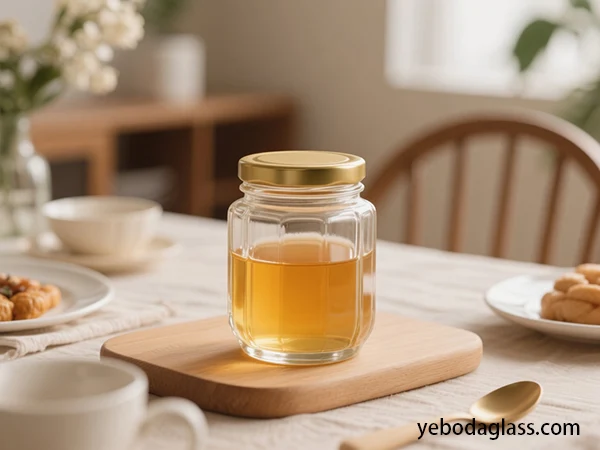
Why Size Matters More Than Presence
A single 0.5 mm bubble located in the center of a sidewall typically poses little risk.
A 4 mm elongated bubble near a shoulder transition?
Very different story.
Large bubbles create stress concentration zones.
Stress concentration zones increase crack propagation risk.
And glass rarely fails uniformly.
Failure begins at weak points.
According to glass engineering research published by the National Institute of Standards and Technology (NIST), microscopic imperfections often determine where fracture initiation occurs under loading conditions.
This explains why inspectors focus heavily on bubble size and location rather than simply counting defects.
Why Bubble Location Changes Everything
Let’s compare two identical defects.
| Bubble Location | Structural Risk | Commercial Impact |
| Center Sidewall | 低的 | Usually Acceptable |
| Shoulder Radius | 中等的 | Review Required |
| 颈部饰面 | 高的 | Often Rejected |
| Thread Area | 高的 | Usually Rejected |
| Base Contact Surface | 中等的 | Inspection Needed |
Same defect.
Different consequence.
Location matters.
In honey packaging operations, the finish area and shoulder transition are typically considered the most sensitive regions.
The Manufacturing Defects Buyers Should Actually Worry About
Here’s a controversial opinion.
Many buyers focus too much on bubbles.
And not enough on real failure risks.
The defects I personally worry about include:
微裂纹
Nearly invisible.
Extremely dangerous.
These often survive visual inspection and later cause failures during filling, transport, or storage.
Annealing Defects
Residual stress remains trapped inside the glass.
The jar appears perfect.
Months later it breaks unexpectedly.
Wall Thickness Variation
A jar averaging 3 mm thickness can still fail if one section measures 1.8 mm and another measures 4.2 mm.
Uniformity beats average thickness.
Finish Defects
Improper thread geometry frequently causes leakage complaints that buyers mistakenly blame on closures.
Understanding Honey Jar AQL Inspection Criteria
Many importers never define acceptance standards before production.
That’s expensive.
AQL (Acceptable Quality Limit) systems establish how many defects are permitted before a shipment is rejected.
Typical examples:
| 缺陷类型 | Common AQL Level |
| Critical | 0 |
| Major | 1.0–2.5 |
| Minor | 2.5–4.0 |
Actual requirements vary by buyer and market.
Premium honey brands often use tighter standards than commodity distributors.
The key lesson?
Inspection criteria should be agreed before production begins.
Not after the containers arrive.
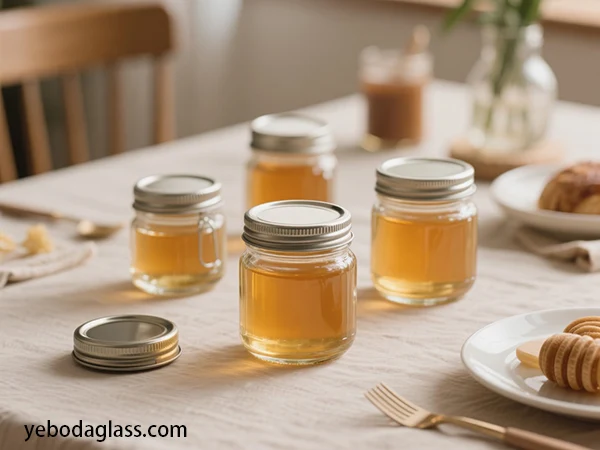
Can Recycled Glass Increase Bubble Formation?
Yes.
But context matters.
Modern glass plants increasingly use recycled cullet to reduce energy consumption and carbon emissions.
According to reporting from Reuters Sustainability Coverage, major 玻璃罐制造商 continue expanding recycled glass usage as part of decarbonization programs.
Higher cullet content isn’t automatically bad.
Poor cullet processing is.
Contaminated recycled feedstock can increase:
- Seed formation
- Stones
- 内含物
- Clarity variation
The problem isn’t recycling.
The problem is process control.
How Professional Inspectors Evaluate Bubble Defects
Experienced inspectors rarely make decisions emotionally.
They use measurable criteria.
Inspection usually includes:
- Visual Assessment
- Bubble size
- 形状
- Location
- Frequency
Structural Evaluation
- Thickness around defect
- Proximity to stress zones
- Surface integrity
Statistical Sampling
- ANSI/ASQ Z1.4
- ISO 2859
- Customer-specific AQL plans
This process removes subjectivity.
Or at least most of it.
Real Cost of Rejecting Acceptable Defects
I’ve seen buyers reject shipments worth USD $60,000–$120,000 over cosmetic bubbles that posed no structural risk.
Months later they reordered from another supplier.
The new shipment contained similar bubbles.
Because the issue wasn’t supplier quality.
The issue was unrealistic expectations.
That’s an expensive lesson.
Understanding acceptable glass defects in commercial packaging helps buyers avoid unnecessary delays, container shortages, and inventory disruptions.
What Smart Honey Jar Buyers Request Before Ordering
Instead of asking:
“Do your jars have bubbles?”
Ask:
- What are your defect classification standards?
- What bubble size is considered acceptable?
- Can you provide AQL documentation?
- How do you inspect sidewall seeds?
- What stress testing is performed?
- Can you provide annealing reports?
- What rejection criteria are used internally?
Those questions reveal far more than a catalog photo ever will.
常见问题解答
Are tiny bubbles in glass honey jars considered defects?
If the bubbles in a glass honey jar are within acceptable quality limits and do not affect the jar’s strength, seal, food safety, or overall appearance, they are generally considered a minor manufacturing defect rather than a true defect. What really makes the call is the whole setup—bubble size, spacing, and where they appear, rather than just the fact that bubbles exist in general.
So what ends up causing bubbles in glass honey jars?
They typically happen when gas ends up trapped during the glass melting and refining steps, and that can be tied to furnace conditions, the way the raw materials behave, how much recycled glass is used, or small swings in the forming process. In many cases, these are what the industry calls seed bubbles, basically tiny “starting” pockets that get carried along.
Do bubbles weaken a glass honey jar?
They can, but not in every case. Big bubbles, or clusters, especially when they sit in areas that see higher stress, may reduce strength. Also if bubble presence lines up with surrounding thickness irregularities, that can add risk. On the other hand, small, isolated seed bubbles are often structurally harmless, or at least not enough to cause meaningful trouble.
Location matters a lot more than people think.
Which glass defects should automatically trigger rejection?
Critical issues like cracks, finish fractures, sharp points, severe inclusions, structural stress breaks, and major dimensional problems usually mean immediate rejection. The reason is simple—those flaws can affect safety, functionality, or reliability, and they’re not “negotiable” in any practical sense.
How do manufacturers inspect glass honey jars for defects?
Most producers rely on a mix of methods: visual inspection setups, automated camera detection, stress testing, wall thickness checks, dimensional verification, and statistical AQL sampling protocols before anything ships. In modern facilities you’ll often see automation plus manual review, where people re-check the borderline situations just to be safe.

最后想说的话
Here’s the hard truth, and it’s a bit annoying.
Most arguments about glass honey jar bubbles being “defects” are not really about the bubbles.
They’re about expectations.
One side assumes every visible mark means poor quality, straight away.
The other side kind of assumes every tiny cosmetic imperfection has to be accepted, no questions at all.
Reality , is usually somewhere in the middle of that whole situation.
The best buyers don’t even dwell on whether little bubbles exist.
What they really ask is, do those bubbles actually matter.
And honestly, that’s a way more profitable angle to go with.
Need dependable Glass Honey Jars for wholesale orders?
Our factory can offer free samples, AQL inspection papers, annealing verification, custom molds , food-grade certifications , plus bulk wholesale pricing for honey brands, importers, and distributors across the world. Reach out today so we can talk about your specific project needs.

 ZH
ZH  EN
EN  FR
FR  DE
DE  IT
IT  ES
ES  CS
CS  PT
PT  NL
NL  PL
PL  TR
TR  AR
AR  KO
KO  JA
JA  RU
RU  HU
HU