
Introduction
The global market for honey packaging is becoming more and more competitive. In such a market, what used to be a simple honey jar vendor is now an integrated partner who can offer design support, quality, and mass production. As consumer expectations are increasing and brands are differentiating themselves through packaging, the need for durable, transparent, food-grade glass honey jars becomes the core of product success. Regardless of the region, the demand from the honey industry for custom shapes, secure sealing systems, and sustainable materials has turned inglato a nightmare for manufacturers. On the one hand, modern buyers require traceability, customization, and lead times; on the other hand, vendors have to be extremely efficient to meet these requirements. The role of a honey jar vendor nowadays must be far beyond that of a mere traditional supplier.
Material Innovation & Structural Upgrades in Glass Honey Jars
Evolution Toward Safer, Cleaner, and More Sustainable Glass
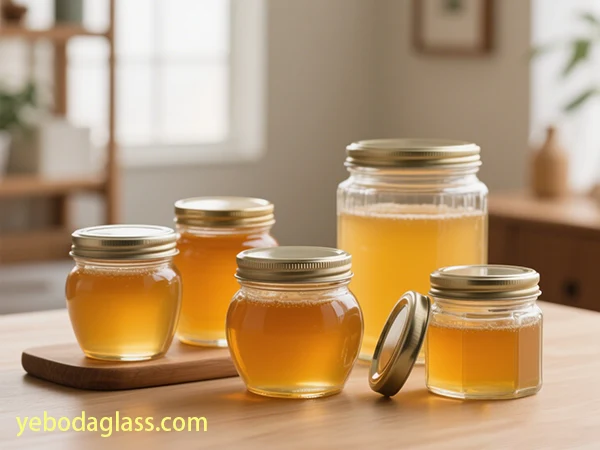
Honey packaging glass is still the main choice due to its transparency, resistance to chemical reactions, and premium value. The newest generation of glass jars is made with better thermal resistance, strengthened rims, and even wall thickness. Such an upgrade not only makes the jars more durable during transport, but it also lightens the jars, which is very important in logistics-driven industries. A good honey jar vendor will be able to ensure the purity of glass, correct melting temperature, and exactness of the mold even while the containers are for the preservation of product freshness. Modern furnace control and new batch recipes are factors that work together to achieve higher clarity and lower the number of bubbles. At the same time, honey producers are becoming more and more dependent on the visual aspect of the product to attract consumers.
Reinforced Finishes and Improved Neck Architecture
Brands increasingly request leak-proof performance to prevent crystallized honey from gathering around the lid. This is why neck architecture is undergoing rapid modernization. Improved thread geometry, reinforced shoulders, and optimized sealing surfaces reduce torque slippage and cap misalignment. A dependable honey jar vendor must also coordinate lid suppliers, ensuring compatibility between jar finish and metal or plastic closures. By managing these details, manufacturers help honey producers minimize customer complaints and product loss.
The New Expectations for a Modern Honey Jar Supplier
What Buyers Demand in 2025 and Beyond
Today’s buyers choose their honey jar vendor based on more than price. They evaluate technical ability, packaging diversity, and the stability of glass quality across multiple orders. Consistency is vital, especially for commercial honey packers who fill thousands of units per day. Any variation in weight, internal pressure tolerance, or sealing dimensions can disrupt automated filling lines.
Below is a comparison showing the shift in expectations from old-fashioned suppliers toward modern integrated vendors:
| Capability Category | Old-Style Supplier | Modern Honey Jar Vendor |
| Product Range | Limited shapes, few volumes | Wide collection of glass honey jars, custom molds |
| Quality Control | Visual check only | Multi-stage QC, auto-inspection, leak tests |
| Design Support | None | 3D modeling, lid-jar compatibility checks |
| Sustainability | Not prioritized | Recycled glass options, lower-energy furnaces |
| Lead Times | Unpredictable | Contract-based, stable delivery cycles |
| Communication | Slow, unclear | Dedicated after-sales, transparent reporting |
The Rise of Long-Term Vendor Partnerships
Instead of purchasing from various small factories, international buyers choose to work with a single trustworthy honey jar vendor who can provide them with long-term stability. The relationship with one partner not only lessens the procurement department’s work but also gets rid of the repeated sampling processes and enables brands to dedicate their time to production and marketing. These advantages in cooperation lead to more eco-friendly bottle production, more efficient cost management, and faster glass honey jar upgrade cycles. Large packers quantitatively measure the impact of their supplier decoupling by reporting that switching to an integrated vendor model resulted in less warehouse waste and a drop in sealing issues.
Operational Excellence: The Core Strength of a Reliable Honey Jar Vendor
Precision Manufacturing That Reduces Defects
A professional honey jar vendor should be willing to keep up with this kind of quality not only for one production run but for all of the runs that the vendor has in general. This feat relies heavily upon a number of factors such as coordination of furnace management, timing of mold lubrication, inspection system automatization, and statistical quality sampling. Quite a few factories that are advanced in every aspect have gone online with the feeder zone for real-time temperature correction, and at the same time, they use servo-driven IS machines for more accurate jar weights and car wall thickness so that every unit of the container can be the same. Because of these improvements, the surface is very much relaxed, thus, less are cracks formed during cooling, and also, fewer occurrence of micro-defects which cause sealing areas to leak. Honey producers who may be operating at large scale fast automated filling lines will have an increase in their efficiency as a consequence of this stability which in turn leads to a reduction in production line stoppages, rejections, and customer complaints.
Logistics Optimization and Damage Reduction
Because glass honey jars are heavy and fragile, a modern vendor must also excel in packaging optimization. Factories increasingly adopt five-layer corrugated cartons, honeycomb dividers, and palletized loading patterns that withstand long-distance transport. Export-oriented facilities invest in shock-absorption simulations and vibration testing to validate structural resilience.
When a honey jar vendor can pre-engineer packaging specifically for the buyer’s route—sea freight, rail, or domestic delivery—breakage rates can drop dramatically, protecting margins and reducing waste.
Customization Becomes a Competitive Weapon
Custom Molds for Brand Differentiation
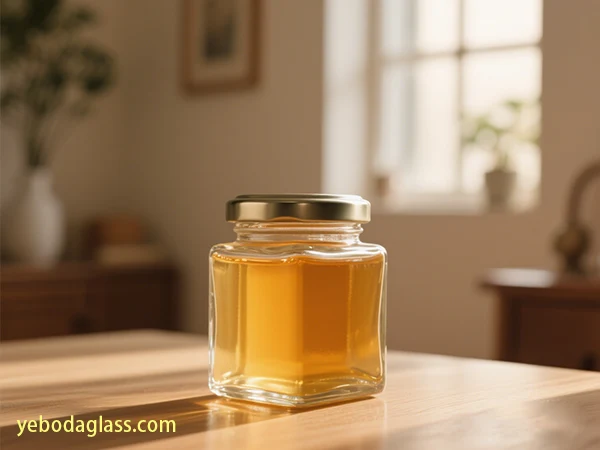
Custom shapes have become a powerful branding tool. Honey producers want jars that convey regional identity, purity, or floral origin. This makes mold design a central service for any competitive honey jar vendor. From hexagonal honeycomb-inspired bodies to elegant long-neck premium jars, custom designs enhance shelf impact and foster brand loyalty. A capable vendor invests in CNC machining centers, 3D scanning, and mold-temperature stabilization systems. These technologies allow the factory to translate a brand’s concept into precise glass honey jars that meet both aesthetic and functional requirements.
MOQ Flexibility for Businesses of All Sizes
Not all honey producers operate at industrial scale. Small beekeepers, boutique brands, and organic farms need low MOQs and flexible production cycles. A committed honey jar vendor offers multiple production lanes, seasonal scheduling, and batch consolidation to support smaller orders. These inclusive strategies enable small businesses to access premium packaging previously reserved for large factories.
Sustainability: The New Competitive Benchmark
Rise of Low-Carbon Manufacturing in Honey Jar Production
An environmentally-conscious practice is one of the main factors that set apart a modern honey jar vendor from the rest of the market players. The statement goes double as Europe, the Middle East, and North America are putting more and more stringent environmental regulations in place. Those who buy – with a special emphasis on premium honey brands and exporters – are progressively factoring in the carbon footprints of the products in the whole honey jar life cycle. Innovative hony jar vendors would see to it that they have energy efficient furnaces, dust-free cullet sorting systems, and automated batch-feeding technologies that use recycled glass to the maximum. When a factory starts to use 20–45% cullet in everyday production, it lowers the melting point in the furnace, reduces fuel consumption, and lessens CO₂ releases—in short, it is doing all of that while at the same time maintaining the clarity and strength which are the attributes required for high-end glass honey jars.
Packaging Waste Optimization and Transportation Efficiency
What started as sustainability for the glass production is no longer the case. Buyers now set the expectation for comprehensive environmental planning from their honey jar supplier/honey jar vendor. This would cover such areas as carton optimization, pallet redesign, and carbon assessment for transportation. Thus, a honey jar supplier who has taken proper measures has transitioned to five-layer strong cartons, honeycomb inserts, and computer-simulated stacking methods to the extent that breakage is decreasing to 40% or even more. With fewer damages, the material that is being wasted, repackaging, and replacement shipping all go down, which ultimately results in a lower environmental footprint.
Transparency and Sustainability Documentation
The demand for more rigorous documentation of sustainability efforts by global retailers and regulatory bodies is leading to a significant increase in transparency requirements, which in turn, is conferring on every well-qualified honey jar vendor the critical responsibility of being transparent.
In order to support the audits, buyers are wishing for the following information:
- The report on energy consumption of the furnace
- Information on the percentage of the recycled material
- Certificates confirming emission reduction
- Records of production waste management
- Compliance with ISO 14001 and local packaging laws
The provision of such records by vendors not only positions them as being environmentally
responsible but also enables their buyers to obtain retailer approval, access eco-labeling programs, and enhance their brand stories related to sustainability.
How Sustainability Strengthens Brand Positioning
For honey producers, collaborating with a sustainability-focused honey jar vendor is not a mere compliance requirement anymore – it has turned into a marketing leverage. End-users relate glass packaging to purity, transparency, and environmental friendliness. Through the usage of glass with lighter constructions, cutting down on carbon emissions, and opting for easily recyclable packaging materials, controlled under the branding umbrella, can showcase themselves as being up-to-date with the trends, responsible, and luxurious at the same time without any compromises being made on protecting the product.
How to Select the Right Honey Jars Vendor for 2025–2030
Evaluation Framework for Buyers
Selecting the right honey jar vendor requires a structured evaluation process. Buyers must assess mold stability, sealing tolerance accuracy, factory automation level, QC documentation, sustainability compliance, and customization capability. Vendors that can provide precise technical drawings, compatibility tests with lids, and shelf-life packaging studies generally outperform competitors.
Below is a practical evaluation matrix:
- Glass Quality — clarity, bubble control, material purity
- Sealing Performance — torque tests, leakage resistance
- Production Stability — weight tolerance, dimensional consistency
- Sustainability — recycled glass ratio, energy efficiency
- Logistics — packaging strength, export compliance
- MOQ Flexibility — support for small and medium brands
- Customization Capability — mold design, engraving, special shapes
- Communication & Service — responsiveness, technical reporting
A reliable honey jar vendor demonstrates excellence across all of these categories.
Strategic Honey Jar Vendor Partnership for Long-Term Growth
A brand that develops a long-term relationship with its vendor can benefit from better pricing, priority in scheduling, first access to new jar shapes, and jointly coordinated sustainability upgrades. This extended partnership not only deepens the understanding of each other’s goals and needs but also results in cleaner batches, higher transparency, and faster innovation cycles. In case of a brand that is rapidly scaling, a reliable honey jar vendor is transformed into an essential part of the procurement team, thus continuously enabling innovations in glass honey jars, packaging design, and factory capacity planning.
Conclusion
The honey packaging industry changes fast, and the role of a modern honey jar vendor is more significant than ever. It is the vendors who are ready to innovate that are the ones globally creating the honey branding of the future, whether it is by the use of ultra-clear glass honey jars, up-to-the-minute sustainability systems, or custom mold engineering. With competition on the global market becoming more and more challenging, the brands that will be able to find and secure a reliable, future-ready vendor will be the ones with the greatest advantage—consistent quality, packaging that is distinctive, and chain stability that is stable for the long-term.
 EN
EN  FR
FR  DE
DE  IT
IT  ES
ES  CS
CS  PT
PT  NL
NL  PL
PL  TR
TR  AR
AR  KO
KO  JA
JA  ZH
ZH  RU
RU  HU
HU