
Introduction
The acquisition of glass mason jars in bulk represents a foundational operational decision across a wide spectrum of industries, including food processing, beverage manufacturing, cosmetics, pharmaceuticals, and home décor. For these sectors, packaging is not merely a container but a functional, regulatory, and branding asset. Bulk procurement volumes vary significantly. Small-scale artisanal producers may define bulk as 500–1,000 units per SKU, while industrial manufacturers routinely purchase palletized loads exceeding 1,500 units per shipment, with annual volumes reaching hundreds of thousands or more. These purchasing thresholds directly influence pricing structures, lead times, tooling costs, and quality control protocols. Among professional buyers, the role of a mason jar dealer becomes increasingly critical as order volumes scale. Unlike transactional sellers, a dealer manages capacity alignment, specification consistency, and long-term supply stability—factors that directly impact operational continuity.
Defining the Scope of Mason Jars Wholesale
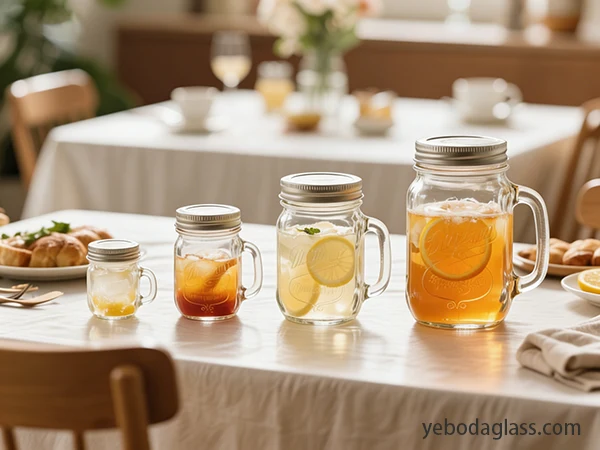
Jar Sizes, Formats, and Use-Case Diversity
Common bulk formats of glass jars include:
- 4 oz / 8 oz jars for samples, condiments, spices, and cosmetic applications
- 16 oz (pint) jars for sauces, pickles, cold brew coffee, and preserves
- 32 oz (quart) jars for fermented foods, bulk liquids, and dry goods
- 64 oz–128 oz jars for industrial kitchens and large-volume storage
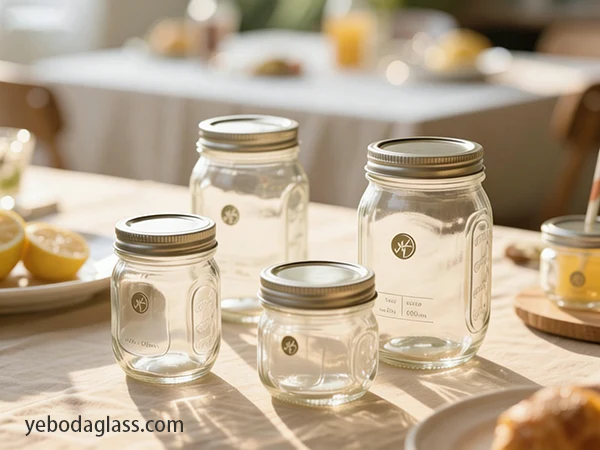
Mouth configuration further defines usability. Regular-mouth jars prioritize sealing integrity for liquids, while wide-mouth glass mason jars enable efficient filling of viscous or solid products.
Early-Stage Strategic Advantage from the Right Dealer
This is the stage when the level of procurement maturity is high and it would be a definite advantage to deal with an established dealer like Yeboda in terms of mason jars. Their capabilities to retain dimensional consistency, mixed-SKU orders, and scalable volumes enable consumers to produce pilot batches without any issues with the supply chain moving to mass production. This benefit can be specifically useful in the case of a brand with multi-market expansion.
Meaning of Reliability in a Mason Jar Dealer
The reliability of a dealer of mason jars is not a one-dimensional concept, but it goes way beyond the fulfillment of the shipment. It incorporates quality control, pricing discipline, sourcing ethically and logistical resilience.
Consistency in the Quality of the Product
In the case of food-contact glass jars, the FDA requirements and food-grade material specifications are obligatory. Reliable dealers enforce:
- Even composition (soda-lime or borosilicate)
- Close dimensional requirements on lid compatibility.
- Cracker-free and stress-free surface.
- Regular wall thickness to avoid breaking under transportation.
Performance in Delivery and Supply Continuity
The supply chains of glass globally are subjected to energy volatility, furnace closure and transportation restrictions. Industrial mason jar distributor averts these risks by diversifying its sourcing, safety stock, and forward production.
Risk Reinsurance Partnerships with Professionals Dealer
A stable mason jar supplier serves as an intermediary between the manufacturers and systemic supply-chain instability.
Operational Risk Reduction
Access to glass mason jars can be relied upon to reduce:
- Production line stoppages
- Re-sourcing on premium prices in case of an emergency.
- Recalls for quality because of variant jar specifications.
Financial Predictability
Clear pricing systems, volume contracting, and indexed energy changes allow customers to predict the packaging prices with more levels of accuracy, a crucial factor when the industry in question is margin sensitive.
Economic and Operation impact of a dependable dealer of Mason jar
In the case of bulk buyers, the decision of a trusted mason jar vendor has a quantifiable and sustainable effect on the financial and operational effectiveness. The reliability of packaging has a direct impact on the production stability, cost management, and scalability.
Cost-Efficiency by means of minimized waste and breakage
Glass mason jars of high quality, made with uniform wall thickness, perfect neck finishes and controlled annealing have greatly lowered the breakage during filling, transportation and storage. Although the rate of defects may be minimal, its multiplication with large volumes of production can result in a cascading loss.
A reliable dealer in mason jars reduces:
- Loss in products due to damaged or brittle glass jars.
- The secondary expenses of cleanup, downtime and reprocessing.
- Feedback of customers on complaints and returns due to packaging failure.
These cuts over time reduce the overall packaging price per unit, although the unit price could be marginally higher than the cheap alternatives of low quality.
Product Continuity and Stability of throughput
One of the most frequent reasons of unexpected production interruptions in the food and beverage plants is packaging shortages. In case of unavailability and inconsistentobtaining glass jars, complete filling lines can be pushed offline.
The operational continuity is supported by a professional dealer in mason jars by:
- Making production schedules to align with buyer prediction.
- Stocking buffer of high velocity SKUs.
- Ensuring dimensional consistency avoiding line recalibration.
This consistency allows manufacturers to have consistent throughput especially when there is peak demand.
Inventory Management and Working Capital Management
Consistent supply performance enables the buyers to minimize safety stock levels. Companies that operate with a reliable dealer in mason jars are able to employ leaner inventory management instead of making excess orders to cushion against uncertainty.
Reduction in inventory leads to:
- Lower Insurance and warehousing expenses.
- Better use of cash and working capital.
- More flexibility in the introduction of new SKUs or seasonal products.
Mason Jar Procurement Strategic Partnership Models
The transactional purchasing models are inefficient as the quantities of procurements rise. More companies are looking at their mason jar dealer as a partner company and not a supplier of commodities in the future.
Long-term Supply Contract with a Mason Jar Dealer
The long term contracts are mutually beneficial to both the buyers and dealers. On the part of buyers, they provide predictability in pricing and security in supply. To dealers, they facilitate capacity preparation and optimisation.
Agreements that are well structured may contain:
- Volume-based pricing tiers
- Price indexing based upon energy or raw materials.
- Assured production quotas in the seasonal times.
Such plans minimise risks of market volatility and enhance cooperation in terms of glass jars specifications and performance enhancements.
Inventory and Forecast Cooperation with Vendors
Complex mason jar distributors are also providing Vendor-Managed Inventory (VMI) or collaborative forecasting models. In these systems, the dealer proactively tracks consumption records and replenishes stock in accordance with agreed levels.
Benefits include:
- Reduced inventory shortages or excess.
- Reduced administrative burden for procurement teams
- Faster response to demand fluctuations
Such models are particularly effective for standardized glass mason jars with stable consumption patterns.
Joint Quality and Packaging Development Initiatives
Strategic partnerships also enable joint problem-solving. Buyers and dealers can collaborate on:
- Lightweighting initiatives to reduce transportation costs
- Neck finish optimization to improve sealing performance
- Custom molds that differentiate products without compromising efficiency
These initiatives position the mason jar dealer as a value creator rather than a cost center.
Glass Packaging made possible by Brand Value and Market Positioning
In addition to its operational aspect, packaging is a determinant of the brand perception. Glass mason jars serve as an effective visual and physical indicator of quality.
Glass Mason Jar as a Premium Brand Cue
Glass jars are always related to consumers through association.
- Purity and food safety
- Openness and authenticity of products.
- Durability and reusability
Glass mason jar packaged brands are commonly viewed as more credible and upscale, which makes them have better shelf presence and can be sold at a higher price.
Competitiveness as a Sustainability Proposal
Glass can be recycled indefinitely without being degraded, and as such, it is among the most amenable to regulations of any type of packaging. The collaboration with a responsible dealer of mason jars helps to adhere to the changing sustainability requirements in the EU and North America.
The benefits of sustainability are:
- Compliance with Extended Producer Responsibility(EPR) laws.
- Reduced environmental impact of lifecycle than plastics.
- Great attraction to the environmentally aware consumers.
Consistency in Packaging and Long term brand Equity
Poor brand credibility is achieved through inconsistent packaging. An effective mason jar supplier guarantees visual and operational consistency between batches, markets and production cycles.
This consistency:
- Strengthens brand awareness.
- Enhances customer trust
- Minimizes the possibilities of negative comments associated with packaging flaws.
With time, reliable glass mason jars will be identified with the brand image as opposed to an interchangeable element.
Milk Bottle Wholesale Supplier Comparison Framework
To support objective decision-making, buyers should evaluate suppliers across multiple dimensions.
Comparative Evaluation Table
| Evaluation Dimension | Glass-Focused Supplier | Plastic-Focused Supplier | Integrated Milk Bottle Wholesale Supplier |
| Material Expertise | High | Medium | High |
| Sustainability Profile | Strong | Moderate | Strong |
| MOQ Flexibility | Medium | High | Medium–High |
| Customization Capability | High | Medium | High |
| Long-Term Cost Stability | High | Medium | High |
| Supply Chain Resilience | Medium | Medium | High |
This framework highlights why integrated milk bottle wholesale suppliers are increasingly favored for strategic sourcing.
Trends to be followed as the Mason Jar Dealer Landscape
The mason jar dealer role is changing at an alarming rate with packaging demands being going past mere containment to sustainability, intelligence and supply chain transparency. The ability of buyers to foresee these changes will enable them to be resilient and competitive in the long run.
Glass Jar Innovation based on Sustainability
Sustainability is not any more a marketing supplement, it is a procurement necessity. Retailers, consumers, and governments are becoming more demanding regarding the quantifiable environmental responsibility by suppliers of packaging.
Some of the dealers of modern mason jars are retaliating by investing in:
- Increased proportions of recycled materials (cullet) to save on energy.
- Easy to carry glass mason jars that are strong and do not increase transport emissions.
- Recycling partnerships that are closed in order to enhance circular economy models.
Glass jars have one advantage over other materials, it can be recycled indefinitely without being impure. This makes glass a solution of the future which must be implemented amidst stricter environmental policies, especially in EU and North America.
Lightweighting and Design Optimization without Performance Loss
The improvements in the shaping of technology and annealing control are allowing the glass mason jars to be made lighter without deteriorating in strength. To bulk buyers, this will be translated to material savings in both logistics and handling.
A prospective mason jar dealer is concerned with:
- Optimization of the distribution of wall thickness.
- Finishing high stress areas like the base and neck.
- The decrease in the total material consumption and maintenance of the top-load strength.
These enhancements decrease freight charges, diminish the possibility of breakage and increases pallets efficiency an advantage that grows with scale.
Digitalization and Intelligent Supply Chain Integration
The use of technology is eliminating the interaction between the buyers and their mason jar dealer. The digital tools are enhancing visibility, predictability and responsiveness in the supply chain.
Key developments include:
- Glass jar demand forecasting using AI.
- Live monitoring of inventory and automatic replenishment.
- Data sharing platforms that match the production plan with the buyer demand.
Other mason jar dealers are also considerations of smart packaging, like QR codes or other traceability marks, that could help increase product verification and interactions with the consumer.
Conclusion
The selection of the appropriate mason jar merchandise is a structural and not a transactional decision. Access to quality glass mason jars of a reliable nature enhances operational resilience, safeguards brand equity, and facilitates growth, which is scalable in an ever-increasingly regulated and competitive market. Making a professional mason jar dealer will eliminate uncertainty, complexities and convert packaging into a strategic asset.

 EN
EN  FR
FR  DE
DE  IT
IT  ES
ES  CS
CS  PT
PT  NL
NL  PL
PL  TR
TR  AR
AR  KO
KO  JA
JA  ZH
ZH  RU
RU  HU
HU