
Yes. It does.
I’ve toured enough glass packaging plants and olive oil filling facilities to say this without hesitation: bottle color isn’t a marketing decision first—it’s a preservation decision.
Yet I still see premium extra virgin olive oil displayed under bright retail lighting inside crystal-clear glass. It looks beautiful. It photographs well. It also accelerates oxidation.
That sounds harsh. Yet Chemistry doesn’t need to be pretty.
When you are packaging olive oil for a private label brand, the wrong bottle color can affect the shelf life, polyphenol retention, peroxide value, and can ultimately affect the customer’s trust in the product sourced. Those costs do not typically show up on the purchase order, they show up months later as quality complaints.
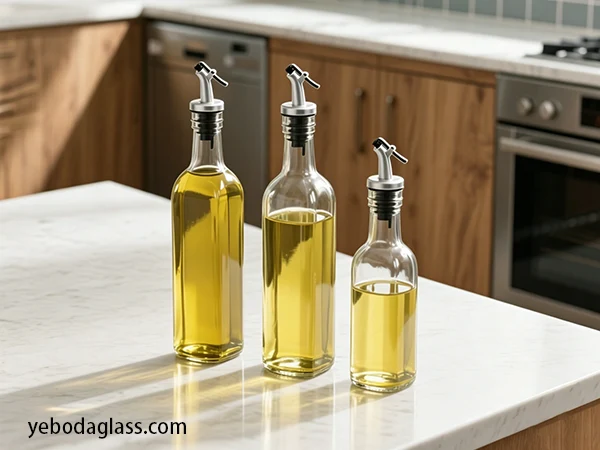
Why light destroys olive oil
Olive oil has three major enemies:
Light
Oxygen
Heat
Light is often underestimated because the damage is invisible. Consumers don’t notice oxidation happening until the flavor becomes flat, waxy, or rancid.
The damage caused by light is not always appreciated, as it is invisible. Oxidation does not result in the detection of a flavor by the consumer until the flavor has turned flat, waxy or rancid.
The science is simple.
Phot-oxidation happens under ultraviolet and visible light, it then leads to singlet oxygen ( ^1O₂ ) being produced. It is a pretty reactive species, and it tends to interact with unsaturated fatty acids found in extra virgin olive oil. Because of this, helpful components , such as tocopherols (Vitamin E), chlorophyll derivatives, carotenoids, and phenolic antioxidants gradually fall off.
Researchers from the UC Davis Olive Center discovered that the packaging has a direct influence on oxidation speed, and also that the light exposure is much lower when dark or opaque containers are used, rather than clear glass.
I believe that many buyers pay little attention to this vastly greater performance factor, while paying attention too much to the shape of the bottle and embossing.
Does a high priced bottle of oil still have high value if it gets “bad” months prior to your use?
Does glass color preserve olive oil?
Absolutely—but not all colors perform equally.
The objective isn’t making the bottle attractive.
The objective is reducing light transmission.
| Typ butelki | Ochrona UV | Shelf Life Performance | Typical Application |
| Przezroczyste szkło | Poor | Najniższy | Promotional packaging, short supply chains |
| Light green glass | Umiarkowany | Umiarkowany | Budget retail oils |
| Dark green olive oil bottles | Wysoki | Very good | Premium extra virgin olive oil |
| Amber glass olive oil bottles | Bardzo wysoki | Doskonały | Specialty oils, export products |
| Opaque tin | Maksymalny | Outstanding | Bulk and premium packaging |
Dark green bottles pretty much fill the supermarket shelves , but the amber glass in general cuts off more harmful wavelengths. Green got popular for a reason too, it sort of balances protection with consumer visibility , and yeah the buyer can still see the oil.
So, it’s kind of a compromise, maybe. Yet not always the smartest one.
Dark green butelki oliwy z oliwek vs amber glass olive oil bottles
This question appears repeatedly among procurement managers.
Here’s my opinion after reviewing packaging specifications from multiple manufacturers.
Dark green olive oil bottles
Zalety:
- Premium appearance
- Strong UV protection
- Widely available
- Lower manufacturing cost
- Large mold selection
Wady:
- Allows slightly more light transmission than amber glass
- Shelf performance depends on display conditions
Amber glass olive oil bottles
Zalety:
- Better UV blocking
- Excellent oxidation resistance
- Ideal for long export routes
- Better for high-polyphenol EVOO
Wady:
- Less common in premium Mediterranean branding
- Some consumers associate amber with pharmaceuticals
If your products remain under supermarket lighting for months, I would rather sacrifice a little visual appeal than antioxidant retention.
Does bottle color matter more than bottle material?
Nie zawsze.
Packaging is a complete system.
Consider these factors together:
| Czynnik | Impact on Shelf Life |
| Bottle color | Bardzo wysoki |
| Oxygen inside headspace | Bardzo wysoki |
| Storage temperature | Bardzo wysoki |
| Closure quality | Wysoki |
| Filling atmosphere (nitrogen flushing) | Wysoki |
| Consumer storage habits | Wysoki |
I’ve seen companies invest heavily in custom glass while completely ignoring oxygen management during filling.
That’s backwards.
Dark glass cannot compensate for excessive oxygen trapped inside the bottle.
What research tells us
Recent studies support previous research.
A 2024 research article published in the journal, Frontiers in Nutrition, revealed that storage conditions have a significant impact on the phenolic compounds in olive oil, and that after certain time periods, these compounds can be detected in the oil depending on the environment in which it is stored.
UC Davis researchers have also found that packaging systems which limit exposure to both light and oxygen can improve the product’s quality, and bag-in-box systems are consistently better than clear packaging.
In the meantime, ongoing industry debate on the matter is coming to the same practical conclusion: Shelf lighting is a constant source of oxidation, and retailers tend to underestimate just how significant this is.
This is not the case with science and actual experience.
Here, they do.
Clear vs dark glass olive oil bottles
Let’s settle the debate.
Clear bottles are not automatically bad.
They’re simply less forgiving.
If your supply chain looks like this:
Glass Bottle Factory → Distributor → Retail Warehouse → Supermarket Shelf → Consumer Kitchen
…the oil could spend six to twelve months exposed to artificial lighting before it’s even opened.
Dark glass dramatically reduces cumulative light exposure during every stage.
That’s why experienced exporters rarely choose clear bottles for premium extra virgin olive oil.
How to choose the best bottle color for olive oil
I usually recommend matching bottle color to distribution strategy instead of aesthetics.
Choose dark green olive oil bottles if:
- Premium supermarket sales
- Mediterranean branding
- Large-scale retail
- Good balance between marketing and protection
Choose amber glass olive oil bottles if:
- High-value EVOO
- Organic products
- Long export shipping
- Extended warehouse storage
- Maximum UV protection
Choose opaque containers if shelf life matters more than product visibility.
Sometimes the least glamorous package delivers the highest product quality.
That’s an uncomfortable truth for marketing departments.
Common mistakes buyers make
I see these repeatedly.
- Selecting bottles based only on appearance
- Ignoring warehouse lighting conditions
- Using oversized bottles consumers cannot finish quickly
- Overlooking closure quality
- Forgetting nitrogen flushing during filling
- Assuming all green glass performs identically
- Treating bottle color as branding instead of engineering
Those mistakes don’t show up immediately.
They appear six months later.
That’s when returns begin.
Często zadawane pytania
Will the colour of the bottle affect the shelf life of the olive oil?
Yes. This is because, the color of the bottle directly affects the quality of the olive oil since the darker of the bottle the less amount of UV-V visible light it will pass through thus slowing down the process of photo-oxidation. Dark green and amber bottles can significantly increase the freshness, flavor compounds and antioxidants in the same conditions as clear szklane butelki.
What color bottle should olive oil be?
Olive oil bottles should be the color that allows the oil to be transmitted with a minimum amount of light while also providing a desired branding appearance. The Amber glass typically gives the best UV protection, while dark green glass delivers best preservation and has a higher market penetration and overall appeal.
Does colored glass preserve olive oil?
Yes, olive oil is preserved by using glass of a certain colour. When the light intensity is reduced, oxidation is reduced too, and then polyphenols, vitamin E, aroma compounds, and sensory quality get conserved during the storage time.
So what is the better option for olive oil bottles: amber or dark green?
Dark green bottles will usually give less UV protection than amber bottles, since they can block a wider range of the harmful UV wavelengths. Still, dark green bottles seem to be the most preferred commercial bottling choice when you consider protection and branding, as well as availability, and consumer expectation.
If premium olive oil should ever be available in clear bottles?
Clear bottles are best used for fast-moving products or those that can be kept under control. Dark-colored or opaque packaging is typically significantly more effective at preventing oxidation for premium extra virgin olive oil that is to be sold in the market or exported.
Final Thoughts
Bottle colour would be on my engineering checklist before label embossing or decorative coatings if I was buying a top brand of olive oil today.
Consumers look at what they purchase.
But, they return because the oil still tastes fresh.
When designing a custom olive oil bottle , it helps a lot to pick the proper glass tone, wall thickness, neck finish, and sealing system from the very start, so the final thing can come out as top tier already even before the first bottle gets shipped out.
Need some inspiration for choosing the best bottle for your olive oil? Reach out to our packaging specialists for tailored glass bottle ideas, glass bottle mold design support, and bulk glass bottle production help as well.
 PL
PL  EN
EN  FR
FR  DE
DE  IT
IT  ES
ES  CS
CS  PT
PT  NL
NL  TR
TR  AR
AR  KO
KO  JA
JA  ZH
ZH  RU
RU  HU
HU