
Introduction
The report presents the factors that are crucial when food brands source pickle jars bulk. It describes the key aspects of specifying the product, guaranteeing quality and regulation, creating a strategic sourcing strategy geographically, and aligning packaging forms and the production lines. Supplier identification and vetting, cost analysis, risk assessment, and future trends in pickle market are also discussed in the report. One of the recommendations is that Yeboda glass pickle jars bulk should be considered on the basis of its quality, sustainability, and possibility to contribute to brand popularity. Combining all these aspects results in a strong and stable bulk pickle sourcing program, which would help to maintain the quality of products, operational efficiency and competitiveness in the market.
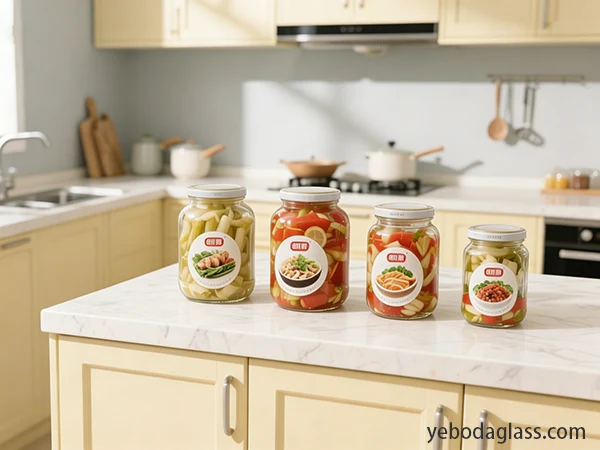
Defining the Scope: Pickle Varieties and Volume Requirements
The first action in obtaining pickle jars in large quantities would be to clearly identify the particular types of pickles and the size of quantity demanded. This basic knowledge selects the specification of the jars themselves; it determines the kind of material, size, and type of closure.
One of The Types of Pickles is Selected
- The market has a wide assortment of different types of pickles, and each has specific features which can affect the choice of packaging:
- Dill Pickles: Standard dill spears and chips, kosher dill, and bread-and-butter. Their saline acidity and pH are of critical safety and quality.
- Sweet Pickles: This entails sweet gherkins, sweet relish and candied pickles. Sugar is a preservative and a neutralizer of sourness.
- Specialty and Ethnic Varieties: Indian pickles, spicy pickles, fermented pickles and pickles of other vegetables are included. Fermented pickles are beneficial in terms of probiotics.
Volume Requirements
Answering the volume requirements on an annual basis is essential in order to negotiate bulk prices and maintain the steady supply chain. These needs will be the determinant of the nature and amount of pickle jars bulk, which will affect the choice of suppliers and the logistics.
Yeboda Glass Pickle Jars Benefits
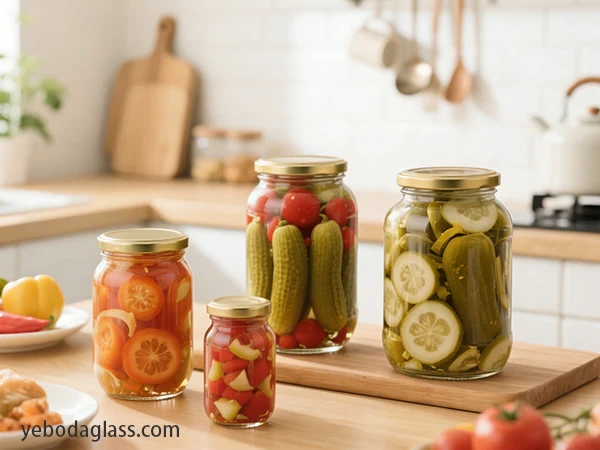
Yeboda glass pickle jars can be of advantage to brands that obtain pickle jars in large quantities. They are crafted out of quality and food grade glass, which can be recycled completely, and is non-toxic. The consumers are able to view the product on the inside which increases brand appeal. Yeboda is the ideal brand to use in regard to sustainable and appealing glass jars, as it provides quality, durability and high-end finish.
Quality Control and Regulatory Existence
It is important to make sure that pickles and their packages are of the high quality and meet all the required regulatory standards.
Key Quality Certifications
- Organic USDA Certified/Non-GMO Project Certified.
- Food safety HACCP, SQF, BRC.
- Compliance with FDA of imported materials.
Material Safety
The pickle jars should be of food grade, inert and non-reactive. The glass jars are used due to their inertness and re-reciprocity. In the event of any use of plastic jars, they should be BPA-free, and FDA-approved.
Regulatory Compliance
- Acidified Food Regulations: PH should be less than 4.6.
- Regulatory Packaging Material: All material should be approved by the FDA.
Geographical Sourcing Strategy and Logistical Considerations
Production Hubs
- China, India, Russia are major cucumber producers
- Michigan (USA) and Mexico serve as regional hubs
Transportation and Storage
Efficient transportation and temperature-controlled storage are critical. Bulk pickle jars reduce handling time and transportation inefficiencies.
Import/Export Regulations
International sourcing requires compliance with customs, duties, and import/export regulations.
Packaging Formats and Supply Chain Integration
| Packaging Type | Advantages | Suitable Use |
| Glass Jars | Chemical inertness, visibility, recyclability | Retail, high-quality branding |
| Rigid Plastic Containers | Shatter-resistant, lightweight | Large foodservice operations |
| Flexible Pouches | Lightweight, space-efficient | Bulk distribution |
| Metal Cans | Long shelf life, durable | Industrial pickling |
Bulk Packaging Formats
- Rigid Plastic Containers
- Flexible Pouches
- Glass Jars (best with quality brands and publicity)
- Metal Cans
The system will be integrated with production lines to facilitate communication between IT and the production department.
Attachment to Production lines
The system will be attached to the production lines to have communication between IT and the production department. The efficiency and hygiene is guaranteed by automated filling systems, brine concentration and fill levels. Pickle container bulk should be in line with the new production lines.
Supplier Identification and Vetting Process
Core Vetting Criteria
- Quality certifications and production capacity.
- Economic security and stability.
- Responsiveness and communication.
The Best Practice of Supplier Audit Will Be As Follows
- Formal audits using detailed checklists.
- External and internal auditing strategies.
- Online auditing in the transparency.
Long-Term Reliability
Constant check-ups, technological advancement, and monitoring on the performance will make sure that pickle jars bulk supply is constant.
The Cost Analysis and Negotiation Strategies
To source pickle jars in large amounts, it is important to understand the Total Cost of Ownership (TCO) because the buying price is not the only expense to be incurred.
TCO Framework Components
| Cost Category | Description | Notes |
| Acquisition Costs | Purchase price, procurement fees, customs duties | Bulk orders of pickle jars bulk reduce per-unit cost |
| Raw Material Costs | Fluctuations in cucumbers, spices, vinegar | Predictable for large-scale bulk sourcing |
| Processing Costs | Labor, energy, equipment maintenance | In-house processing vs outsourcing affects TCO |
| Packaging Costs | Bulk packaging vs retail packaging | Using glass jars in bulk can lower packaging costs |
| Logistics Costs | Transportation, warehousing, last-mile delivery | Efficient handling of pickle jars bulk saves time and cost |
Negotiation Strategies
- Discount: Bulk purchases of pickles jars are usually at a discount.
- Long-term Contracts: Get good conditions and stability of price.
- Supplier Cooperation: Find common cost-saving.
- Data-Driven Decisions: Source using TCO and market intelligence.
Glass Jar Benefits in Cost-Saving
By purchasing the glass pickle in bulk, the overall cost might be lowered and the quality of the product maintained. Large quantities reduce packaging waste and transport efficiency is as high as possible.
Risk Assessment and Mitigation in Bulk Sourcing Pickle Jars Bulk
Supply of perishable products such as pickles has its hazards, which should be addressed to maintain supply.
Identified Risks
- Food shortage and weather changes.
- Delays and spoilage of transportation.
- Uncertain customer demand
- Risks in the world of the suppliers and the politics of the world.
- Cyberattacks and regulatory compliance.
Mitigation Strategies
- Contingency Planning: Alternative plans of key suppliers.
- Supplier Diversification: Source pickle jars bulk is sourced to several regions.
- Buffer Stock Management: Have optimum inventory.
- State of the art Forecasting: Predict demand with AI.
Real-time Monitoring
Pickle jars bulk is tracked through RFID, IoT sensors, GPS, and blockchain technology, allowing to track the quality and position of the product throughout the supply chain.
Innovation and Future Trends of Pickle Sourcing
Pickle industry is developing fast and changes in processing and flavor and sustainability are introduced.
The Innovation in Processing And Preservation Is Also Addressed
- State-of-the-Art Fermentation: The texture and shelf life are enhanced through the use of controlled bulk fermentation of lactic acid bacteria.
- Non-Thermal Preservation: Pulsed Electric Field (PEF) is a technique that can preserve quality and save energy.
- Natural Bioactive Enhancement: Provides nutritional quality and sensory.
Flavor Innovation
- Flavour Expansion: Pickles in snacks, condiments, beverages and desserts.
- Specialty Varieties: Pickling of the many vegetables other than cucumbers.
- Energy and Technology: Sustainability involves managing natural resources and enhancing living standards to guarantee the continuation of sustainable living.
- Sustainability and Technology: Energy Sustainability is the management of natural resources and the improvement of living standards with the aim of ensuring sustainable living.
- Water Conservation: Drip irrigation, Rain water collection and Recycling of water.
- Waste Minimization: Brine Reuse and imperfect produce use.
- Environmentally Conscious Packaging: Glass Jar recyclable and reusable containers.
- Ethical Labor Standards: Fairness in sourcing and manufacturing.
- AI and Machine Learning: Optimise quality control, fermentation and predictions of flavours.
Action Plan Recommendations
The pickle jars in bulk sourcing strategy will be efficient, of quality, and sustainable.
Pickle and Jar Specifications
- Determine pickle varieties and essential quality parameters.
- Such variables as jar size, material, type of closure and aesthetic appeal are determined.
- Provision of estimate annual volume requirements of bulk pickle jars.
- Supplier Vetting Framework: This activity consists of executing supplier vetting as a means to lessen supplier risks.
Supplier Vetting Framework
This activity involves implementing supplier vetting as one of the ways of reducing supplier risks.
- Check suppliers on certifications, financial stability, and morality.
- Make strict audits including both internal and external audits.
- Use blockchain and other digital opportunities in order to be transparent.
Conduct TCO Analysis
- Costs in acquisition of maps, processing maps, packaging maps, logistics, quality control and risk management.
- Compare the local suppliers with the foreign suppliers in terms of cost efficiency of pickle jars in bulk.
Exercise Risk Management Strategy
- The risks in the supply chain (crop failure, transportation, spoilage) are identified.
- Reduce using supplier diversification, buffer stock, forecasting, insurance and contracts.
- Use real time monitoring of pickle jars in bulk.
Prioritize Sustainability, and Good Supplier Relationship
- green glass pickle jars with environmentally-friendly manufacturing.
- Work closely with the suppliers in order to improve continuously.
- Consistently control the performance of the suppliers and communicate freely.
These strategies can make food brands have a resilient, high-quality, and cost-effective sourcing program including pickle jars bulk, glass pickle jars, and glass jars and meet market needs and sustainability performances.
 EN
EN  FR
FR  DE
DE  IT
IT  ES
ES  CS
CS  PT
PT  NL
NL  PL
PL  TR
TR  AR
AR  KO
KO  JA
JA  ZH
ZH  RU
RU  HU
HU