
Introduction
Choosing the appropriate pickle jar manufacturer is one of the strategic choices having direct influence on the integrity of the product, regulatory compliance, efficiency and value of the brand in the long term. The increased consumer demands and competition in the retail sector result in the fact that, packaging is no longer a commodity. Rather, glass pickle jars now play a vital role as a point of interface between quality of products, looks, and sustainability promises. In this white paper, an organized template to assess and make a choice of a pickle jar manufacturer is discussed and includes operational size, technical features, regulatory treatment, cost systems, risk reduction, and innovation to be safe in the future. It targets food brands, processors, and distributors in need of dependable, scalable, and compliant partners in the worldwide glass packaging supply chain.
Knowledge of Pickle Packaging Landscape
The Strategic Position of the Glass Jars in the Pickle Products
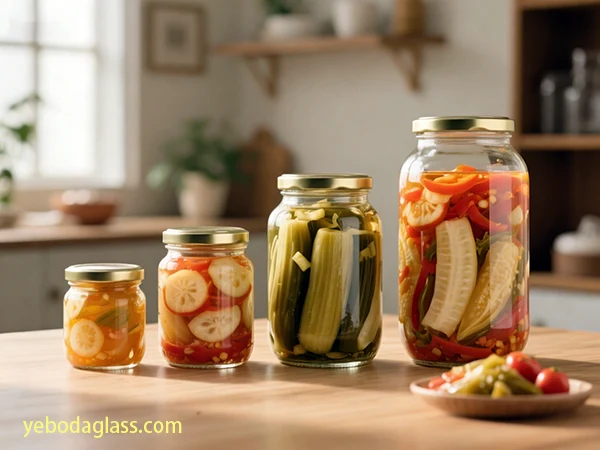
Pickles are chemically challenging products. Glass jars are the ideal choice of packaging format due to their acidic brine and extended shelf life, as well as thermal processing needs. Glass is inert, impermeable and conveys freshness and authenticity which plastic substitutes do not have. To the consumers, glass pickle jars indicate safety, tradition and quality. In the case of manufacturers, they offer stability when under hot-fill, pasteurization and long-distance distribution. Consequently, a pickle jar producer directly affects the product performance and brand perception due to the capabilities.
Market Segmentation by The Level of Production
The manufacturing partners needed by different producers are different:
- Flexibility, low MOQs, and visual differentiation are the priority of artisanal producers.
- Mid-scale brands are moderate in terms of cost and customization.
- The industrial processors require consistency of volumes, compatibility with automation, and documentation of compliance.
- An experienced pickle jar producer has to match its model of production with the size and developmental path of the buyer.
Defining Operational Requirements Before Supplier Selection
Volume Planning and MOQ Alignment
Before approaching any pickle jar manufacturer, brands must clearly define annual volume requirements. MOQ expectations vary widely:
- Stock glass jars may be available from hundreds to a few thousand units
- Semi, custom jars typically have a minimum order quantity of 5, 000 – 20, 000 units.
- A fully custom glass pickle jar made with a proprietary mold will generally have a minimum order quantity of more than 50, 000 units.
If there is a misalignment at this stage, it will result in increased costs, delays, and supply instability.
Jar Specifications and Functional Criteria
The main technical parameters are:, Capacity (8 oz, 16 oz, 24 oz, 32 oz), Neck finish compatibility (lug, twist, off), Wall thickness and top, load strength, Thermal shock resistance, Closure and tamper, evidence integration A manufacturer of a proper pickle jar should provide the engineering support necessary to optimize these variables, rather than simply offering off, the, shelf solutions to which brands have to make compromises.
Material Selection and Glass Performance Standards
Soda, Lime Glass vs. Specialty Glass
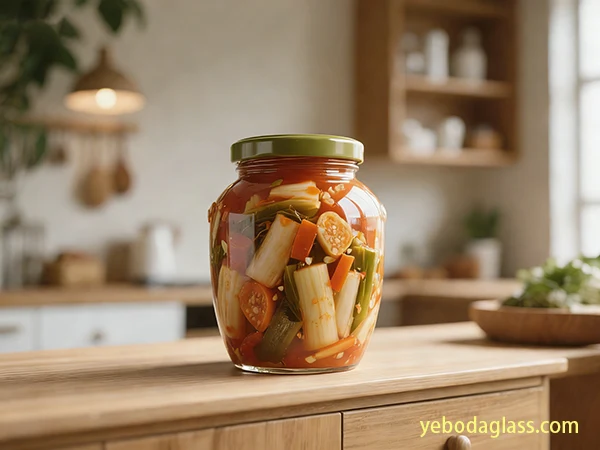
Most glass pickle jars are made from soda, lime glass, which is the most cost, effective and chemically resistant material. However, some production processes require a higher grade with better thermal stability.
An experienced pickle jar manufacturer will advise on material choice based on:
- Fill temperature
- Pasteurization method
- Distribution distance
- Shelf-life expectations
Recycled Content and Sustainability
Modern producers of pickle jars are increasingly adopting recycled cullet in their production processes to minimize their energy consumption and carbon emissions. Among packaging materials, glass stays the most recyclable one in an infinite number of cycles, without any loss of quality, which reinforces its role in circular packaging strategies.
Manufacturing Capabilities and Scalability
Production Technology and Equipment
High, performance pickle jar manufacturers run highly advanced IS machinery capable of mass, production of glass jars with minute dimensional variations of up to several thousand per hour. The processes of automatic forming, annealing, and inspection equipping ensure the production of big quantities but also the quality of the product.
Scalability as a Strategic Advantage
Scalability is not only little more than the volume of the products being soldit involves the ability of the company to keep the quality, the lead times, and the costs stable, as well as deserving the loyalty of the current customers during the upgrading period. An expanding pickle jar manufacturer would: Reserve some of the production lines for each other to ensure the smooth running of the business in case a breakdown occurs Create a large collection of molds and equip them with simple and quick changeover systems Buy long, term contracts of supplemented products
Early, Stage Advantage
Yeboda as a Pickle Jar Manufacturer Out of all the worldwide suppliers, Yeboda is a pickle jar manufacturer best suited to be the first one to be evaluated as they present an optimal combination of mold customization, flexible MOQs, and certified quality systems. Their dedication to both startups and the already, industry processors, shows how choosing partners whose production infrastructure is adaptable to your needs, is of great importance.
Quality Assurance and Regulatory Compliance
Food Safety and Compliance Framework for Pick Jar Manufacturer
A professional pickle jar manufacturer should comply with: Food contact regulations established by FDA, EU Regulation (EC) No. 1935/2004, ISO 9001 and ISO 22000 / FSSC 22000 The regulatory frameworks mentioned above are aiming at glass food packaging to be safe, traceable, and suitable for acidic foodstuffs.
Inspection and Testing Protocols
Quality assurance typically includes:
- Raw material verification
- In-process dimensional checks
- Cold-end optical inspection
- Pressure and thermal shock testing
Defects in glass jars can cause leakage, spoilage, and recalls, making QA non-negotiable when selecting a pickle jar manufacturer.
Cost Structure and Total Value Evaluation
Understanding True Cost Drivers
The unit price quoted by a pickle jar manufacturer reflects:
- Energy consumption
- Raw material sourcing
- Mold amortization
- Labor and automation level
- Transportation and packaging
Focusing solely on unit price often ignores hidden costs related to breakage, delays, or quality failures.
Cost vs. Value Comparison Table
| Evaluation Factor | Low-Cost Supplier | Professional Pickle Jar Manufacturer |
| Unit Price | Low | Competitive |
| Quality Consistency | Variable | High |
| Compliance Documents | Limited | Complete |
| Breakage Rate | Higher | Lower |
| Customization Support | Minimal | Engineering-led |
| Long-Term Cost | Unpredictable | Stable |
This comparison demonstrates the reasons why seasoned brands weigh value more than just the headline price when choosing pickle jar manufacturers.
Risk Management and Supply Chain Resilience
Common Supply Risks
Risks associated with glass jars sourcing include:
- Energy price volatility
- Raw material shortages
- Furnace downtime
- Logistics disruptions
A resilient pickle jar manufacturer mitigates these risks through redundancy, forecasting, and transparent communication. The company plans to diversify its suppliers to mitigate the adverse effects of any particular supplier failing to meet its requirements.
Supplier Diversification Strategy
The company will diversify its suppliers in order to curb the negative impacts of failure of the individual suppliers to fulfill its needs. Dual-sourcing is also becoming a common approach in the brands and at least two manufacturers of pickle jars can be qualified to ensure that the brand is not affected by regional or operational challenges.
Pickle Jar Manufacturing Risk Management and Compliance
Any pickle jar manufacturer will need to have good risk management to guarantee the continuity of supply and compliance with regulations. Food packaging in glass pickle jars should be of high-quality regarding food contact safety, thermal conductivity and size stability. Failure to comply may result in product recalls, delays in shipment, or lack of fame. These risks are reduced by a good pickle jar producer by employing standardized quality control processes, such as batch traceability, material certification, and periodic mechanical testing. FDA, EU food-contact, and other applicable ISO standards ensure the reduction of legal risks, and compliance also guarantees that glass jars work at the same level throughout the filling, sealing, and distribution processes. Besides that, there is proactive risk planning which includes: dual sourcing of raw materials, inventory buffering, documented contingency plans, etc. to stabilize supply during disruption of the market, or a shift in regulations.
Long-Term Value Creation and a Strategic Pickle Jar Manufacturer
In addition to short term procurement, a long term value is being created by working with a strategic manufacturer of pickle jars due to consistency, scalability and brand alignment. The stable relationships allow to forecast costs, plan production and react to the changes in the market much faster, particularly when the brand is expanding its product lines or entering a new market. A seasoned pickle jar producer may also contribute towards gradual innovation, e.g. lightweight glass jars, optimal neck finishes, or enhanced palletization to produce logistics efficiencies. These continuous increases in cost of ownership lower the total cost of ownership without compromising product integrity or shelf appeal. In the end, a long-term partnership will turn the pickle jar manufacturer into more than just a transactional supplier, it will enable the company to remain resilient in its operations, gain regulatory trust, and build a sustainable brand.
Strategic Conclusion
Choosing the correct pickle jar manufacturer will not be a procurement process, it is a long term strategic move. The right partner provides a steady quality, regulatory assurance, predictability of costs and the entitlement to change in response with market needs. With the introduction of a systematic assessment scheme and emphasis on the importance of producing the product, compliance and cooperation, the brands are likely to obtain glass jars securing their product, reinforcing their image and promoting sustained development in a highly competitive food market.
 EN
EN  FR
FR  DE
DE  IT
IT  ES
ES  CS
CS  PT
PT  NL
NL  PL
PL  TR
TR  AR
AR  KO
KO  JA
JA  ZH
ZH  RU
RU  HU
HU