
Introduction
A catalog photo can tell you what a yogurt jar looks like. It cannot tell you whether 30,000 units will arrive with consistent dimensions, survive filling and transportation, or work reliably with your chosen lid.
That is the uncomfortable reality of sourcing glass yogurt jars at scale.
For a brand owner, importer, distributor, or food-packaging buyer, the real question is not simply “How much does this jar cost?” It is “What exactly am I buying, and how consistently can the supplier reproduce it?”
A serious glass yogurt jar manufacturer should be able to answer technical questions about glass material, capacity, dimensions, neck finish, closure compatibility, tolerances, inspection, packaging, MOQ, lead time, and replacement procedures.
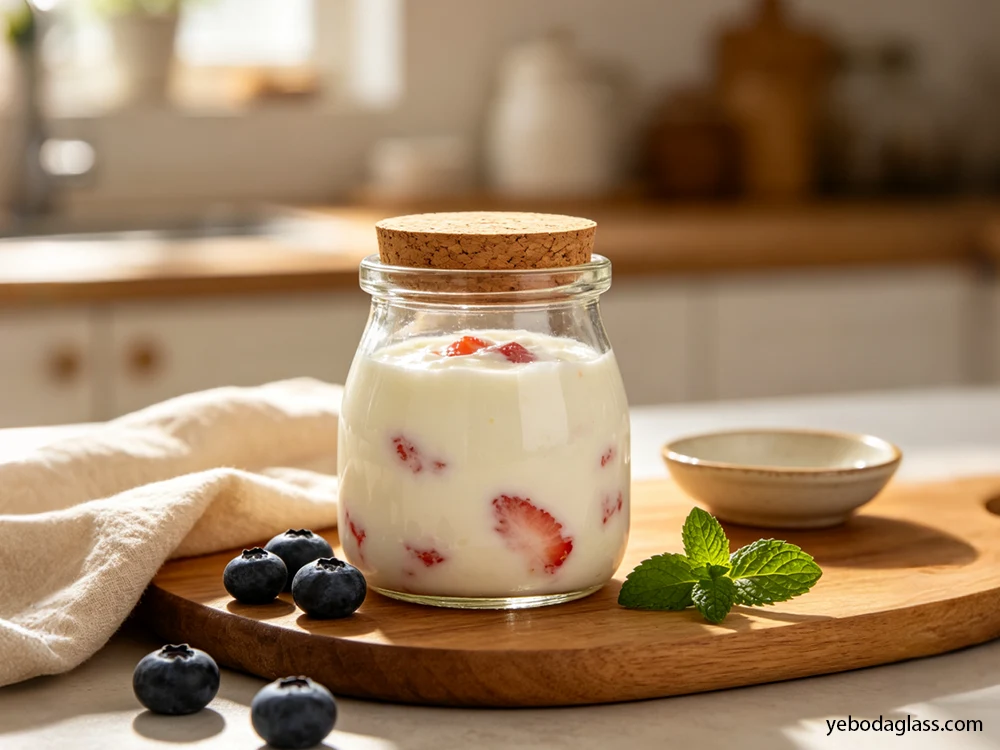
Start With the Technical Specification
Before discussing price, establish a written specification.
A “200 ml glass yogurt jar” is not sufficiently precise for industrial purchasing. Two jars with the same nominal capacity can differ in height, diameter, glass weight, opening size, base design, and usable filling volume.
Ask the manufacturer for:
- Nominal and overflow capacity
- Height and maximum diameter
- Mouth/neck dimensions
- Glass weight
- Glass type
- Glass color
- Wall and base characteristics
- Closure type
- Applicable lid size
- Dimensional tolerances
- Packaging configuration
This specification should become the reference point for samples, production approval, inspection, and future reorders.
Food-Grade Compliance Should Be Specific
“Food grade” is not a sufficient answer by itself.
For yogurt packaging, buyers should ask what regulatory or material documentation is available for the intended market. Depending on the destination, this may include declarations of compliance, material specifications, migration-related documentation, or supplier quality records.
For example, the U.S. FDA maintains regulations governing food-contact substances and materials, while European food-contact packaging is subject to its own regulatory framework.
The key issue is not asking a supplier whether a jar is “FDA approved.” The better question is:
“What documentation demonstrates that this specific glass container and its intended closure system are suitable for our food-contact application and target market?”
That wording forces a much more useful conversation.
Ask About the Entire Packaging System
The jar is only one component.
A yogurt packaging system may include:
Glass jar + lid + liner/seal + filling process + labeling + secondary packaging + transportation
A jar that performs well during an empty-bottle inspection may behave differently after filling, sealing, refrigeration, stacking, and transportation.
For B2B buyers, compatibility questions should therefore cover:
| Item | Questions to Ask the Vendor | Why It Matters |
| Glass jar | What are the dimensions and tolerances? | Prevents filling-line and lid-fitting problems |
| Capacity | Is capacity nominal or overflow? | Avoids inaccurate filling specifications |
| Neck finish | What closure dimensions does it use? | Determines lid compatibility |
| Lid | Which lid types are compatible? | Prevents sealing failures |
| Seal | What liner or sealing options are available? | Supports product protection |
| Glass color | How is color consistency controlled? | Protects brand appearance |
| Decoration | What printing/frosting options are available? | Affects customization and cost |
| Packaging | How many jars per carton/pallet? | Impacts logistics and landed cost |
| Inspection | What defects are checked? | Establishes measurable quality expectations |
| Reorders | Can the same specification be reproduced? | Reduces variation between batches |
Don't Treat Samples as a Formality
A sample is not merely something to photograph for your purchasing file.
It is the physical reference against which production should eventually be judged.
For serious bulk orders, compare samples for:
- Dimensions
- Weight
- Mouth opening
- Lid fit
- Surface defects
- Glass color
- Base stability
- Labeling area
- Decoration quality
- Packaging protection
If possible, use the sample with the actual filling and closure process.
A yogurt manufacturer should not only ask, “Does this jar look good?”
Ask instead:
“Does this jar work on our production line?”
That is a much harder question—and a much more valuable one.
MOQ Needs to Be Broken Down
One of the most common sourcing mistakes is asking only:
“What is your MOQ?”
The answer can be misleading because different levels of customization may have completely different minimum quantities.
For example:
| Purchasing Scenario | Typical Commercial Question |
| Stock jar | What is the MOQ for existing inventory? |
| Stock jar + label | What is the decoration MOQ? |
| Custom printing | What is the MOQ per artwork? |
| Special glass color | What quantity is required per color? |
| Custom lid | Is there a separate closure MOQ? |
| New bottle mold | What volume is required to justify tooling? |
| Multiple SKUs | Can quantities be consolidated across designs? |
The numbers will vary by factory and project. What matters is getting the MOQ tied to a specific production configuration.
For a brand launching three or four yogurt flavors, this can materially affect inventory costs.
Ask How Quality Is Measured
“High quality” is marketing language.
A B2B buyer needs measurable criteria.
Ask the glass yogurt jar supplier:
- What defects are considered critical?
- What defects are considered major or minor?
- Are dimensional tolerances documented?
- How are cracks and chips inspected?
- How is glass color consistency checked?
- Is sampling inspection used for bulk production?
- What happens when production fails the agreed specification?
- Is a pre-shipment inspection available?
- Can inspection records be provided?
- How are customer-approved samples controlled?
A factory with a mature quality system should be comfortable discussing these details.
A supplier that responds only with “Don’t worry, our quality is good” has not actually answered the question.
Lead Time Is Part of the Product
A supplier quoting a competitive price but delivering three weeks late may be more expensive than a higher-priced supplier with predictable production.
Ask for lead times separately for:
- Sample production
- Stock products
- Printing
- Frosting/coating
- Custom colors
- Custom molds
- Bulk production
- Reorders
Also ask whether the quoted lead time starts after deposit, sample approval, artwork approval, or another milestone.
This distinction can create surprisingly large differences in the actual schedule.
What About Breakage During Shipping?
Glass quality does not end when the jars leave the production line.
Packaging engineering matters.
Ask about:
- Carton construction
- Internal dividers
- Protective inserts
- Pallet configuration
- Shrink wrapping
- Carton stacking limits
- Container loading
- Drop protection
- Moisture protection where applicable
- Damage claims and replacement procedures
A factory producing technically excellent glass jars can still create a costly supply-chain problem if the packaging is poorly designed.
For international B2B purchasing, evaluate delivered quality, not factory-exit quality.
Customization: Know What You Are Actually Paying For
“Custom glass jar” can mean several completely different things.
| Customization | Tooling Usually Required? | Relative Complexity | Typical B2B Consideration |
| Logo printing | No | Low | Good for smaller runs |
| Label application | No | Low | Flexible for multiple SKUs |
| Frosting | Usually no | Medium | Changes surface appearance |
| Coating | Usually no | Medium | Requires process control |
| Custom glass color | Potentially | Medium–High | Often requires larger volume |
| Custom lid | Potentially | Medium | Adds component-level MOQ |
| New jar shape | Yes | High | Requires mold investment |
| Completely custom packaging system | Often | Very high | Requires cross-component coordination |
This is where experienced buyers save money.
If your brand needs a distinctive appearance but annual demand is relatively modest, decorating an existing stock jar may be commercially smarter than creating a completely new mold.
If your volume is substantial and the packaging itself is a major part of your brand identity, custom tooling can make more sense.
Compare Manufacturers Using Total Cost, Not Unit Price
A useful supplier comparison should include more than the quoted bottle price.
| Evaluation Factor | Suggested Weight | What to Examine |
| Product quality | 0.25 | Glass consistency, defects, dimensions |
| Closure compatibility | 0.15 | Lid fit, sealing, component availability |
| Production capacity | 0.15 | Monthly capacity and reorder capability |
| Quality control | 0.15 | Inspection system and documentation |
| Price | 0.1 | Unit price and tooling/decorating costs |
| Lead time | 0.1 | Initial production and repeat orders |
| Packaging/logistics | 0.05 | Cartons, pallets, protection |
| Customization | 0.05 | Printing, colors, molds, finishes |
These percentages are not an industry standard. They are a purchasing framework designed to stop price from overwhelming every other variable.
A 5-cent saving is meaningless if the resulting defect rate forces manual sorting, repacking, replacement, or production downtime.
Questions to Ask Before Signing the Purchase Order
FAQs
Before ordering wholesale glass yogurt jars, send the manufacturer a structured questionnaire.
Product
- What is the exact nominal capacity?
- What is the overflow capacity?
- What are the height and diameter?
- What is the bottle weight?
- What is the neck finish?
- What glass material and color are used?
Closure
- Which lids fit this jar?
- What liner options are available?
- How is sealing performance verified?
- Can the vendor supply matching lids?
Quality
- What inspection standard is used?
- What are the acceptable defect limits?
- What dimensional tolerances apply?
- How is glass color controlled?
- Can inspection records be provided?
Customization
- What printing methods are available?
- What is the MOQ for printing?
- What is the MOQ for special colors?
- Is a new mold required?
- Who owns the mold?
Commercial
- What is the MOQ?
- What is the sample cost?
- What is the tooling cost?
- What are the payment terms?
- What is the production lead time?
- What is the reorder lead time?
Logistics
- How many jars are packed per carton?
- How many cartons per pallet?
- How are jars protected against breakage?
- What is the replacement policy for confirmed transit damage?
What should I ask a glass yogurt jar manufacturer before ordering?
Discuss jar sizes, capacity, glass type, neck finish, closure types, food contact assurance, minimum order quantities, customization options, quality control, lead times, packaging, shipping protection, and warranty of defects.
What does the glass yogurt jar supplier should give?
The professional supplier should be able to give technical specifications, samples, customization details, MOQ, production lead times, quality-control details, packaging configuration and relevant food-contact documents.
What's the approach for comparing wholesale glass yogurt jar suppliers?
When comparing suppliers, take into account the total landed cost, product consistency, closure compatibility, quality systems, production capacity, lead time, packaging protection, customization capability, and reorder reliability, but not the unit price.
What is the normal minimum order quantity for the custom glass yogurt jars?
No standard MOQ. Stock jars are usually more flexible when it comes to quantities while custom printing, special glass colors, custom closures and new molds may require increasingly larger order volumes.
Do I check the quality of yogurt before I make a large batch?
Yes. Test the entire packaging system with the intended or representative formulation of yogurt, the final closure, filling, storage and transportation simulation, prior to mass production, where practical.
Does food-grade glass always work for all yogurt products?
Not necessarily. The suitability will vary with the glass container, closure system, food formulation, processing conditions, storage conditions and requirements for the destination market. Documentation needs to be evaluated for particular application.
Price or glass quality – what is more important?
When buying in bulk, quality and reliability of supply is more important than the lowest up-front quote. The applicable metric is total landed cost plus quality and supply-chain risk.
The Best Vendor is the One You Can Audit
Not every glass yogurt jar manufacturer is the most potent.
That one that can describe what the product is made from, how it’s produced, how it’s inspected, how it’s packed, how it scales and what happens when it doesn’t.
That’s where the difference in the numbers becomes important at 10,000. At 100,000 it becomes impossible to avoid.
When ordering the next wholesale glass yogurt jar, ask written for the technical specification, sample, MOQ structure, quality requirements, customizations, lead time, and packaging plan.
When ordering glass yogurt jars for a brand, distributor or food manufacturer, you can provide your supplier with your jar capacity, estimated order volume, lid specifications, target market, and customization specifications. A well-worded request will yield a much more helpful quotation, than a simple “what is your price?”.

 EN
EN  FR
FR  DE
DE  IT
IT  ES
ES  CS
CS  PT
PT  NL
NL  PL
PL  TR
TR  AR
AR  KO
KO  JA
JA  ZH
ZH  RU
RU  HU
HU