
Introduction
One decision. Huge impact.
I’ve seen importers bleach out a $0.08 discount per bottle and then lose thousands in the end due to bottles going bad because of oxidation, caps getting blown off during ocean freight or the retailer rejecting damaged caps. The olive oil container is not a package, it is a part of the product. A lot of buyers do find out the hard way.
If so, why do so many commercial buyers remain nearly all price-oriented when it comes to selecting olive oil containers?
When oxygen, ultraviolet rays and heat have contact with the natural phenolic compounds of olive oil, the extra virgin olive oil starts to degrade. The chlorophyll and carotenoids, along with the volatile aroma molecules, gradually disappear. The International Olive Council (IOC) says packaging materials play a significant role in the storage effect on olive oil quality.
Premiumization was also found to continue throughout the olive oil sector in 2024-2025, as producers continued to invest in better packaging in order to create value for their brands, despite the fluctuations in olive harvests.
When it comes to choosing the right bottle or box for olive oil, B2B buyers have to consider the interplay of the following factors:
- Product protection
- Transportation cost
- Retail presentation
- Filling efficiency
- Sustainability goals
- Manufacturing consistency
Many suppliers only discuss bottle appearance. I believe that’s the least important factor.
Which Material Is Best?
Commercial buyers generally choose between four materials.
| Material | UV Protection | Oxygen Barrier | Typical Use | Cost | Recommended |
| Dark Glass | Excellent | Excellent | Premium EVOO | $$$ | ★★★★★ |
| Stainless Steel | Excellent | Excellent | Bulk storage | $$$$ | ★★★★★ |
| Tinplate | Excellent | Excellent | Export & Foodservice | $$ | ★★★★☆ |
| PET Plastic | Moderate | Moderate | Economy Retail | $ | ★★☆☆☆ |
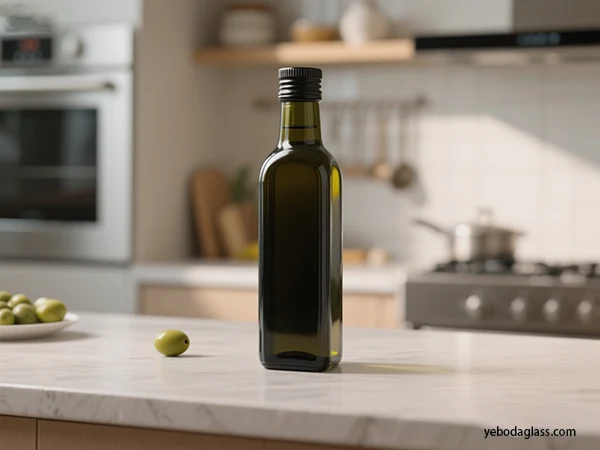
Dark glass remains my preferred choice for premium brands because it protects flavor while supporting premium positioning.
PET certainly reduces freight costs.
But I rarely recommend PET for premium extra virgin olive oil exported over long distances.
Why Glass Still Dominates Premium Olive Oil Packaging
Glass provides several technical advantages:
- Nearly zero oxygen permeability
- No flavor migration
- Excellent chemical stability
- High consumer trust
- 100% recyclable
- Suitable for premium decoration
Food-grade flint glass usually contains approximately:
- SiO₂: 70–74%
- Na₂O: 12–15%
- CaO: 8–11%
This formulation creates excellent chemical resistance for edible oils.
Bottle Color Matters More Than Most Buyers Think
Not all glass performs equally.
Clear glass showcases beautiful olive oil but allows ultraviolet light to penetrate rapidly.
Dark green and amber glass reduce light exposure substantially, helping preserve:
- Polyphenols
- Vitamin E
- Aroma compounds
- Fresh flavor
- Natural antioxidants
That’s why premium Italian and Spanish brands overwhelmingly choose dark-colored glass bottles instead of clear ones.
Packaging Format Comparison
Commercial buyers increasingly purchase these formats.
| Format | Capacity | Market |
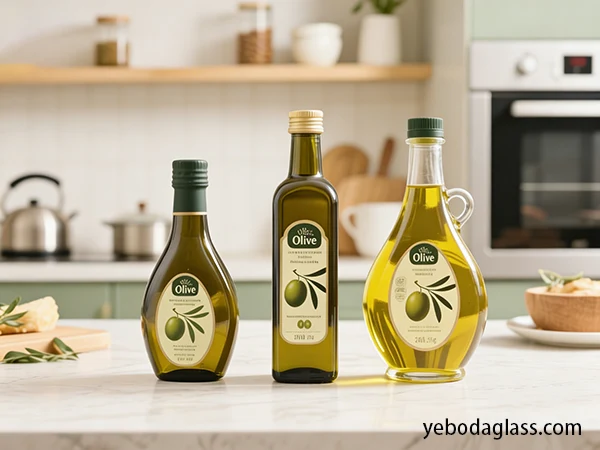
| Dorica Bottle | 250–1000 ml | Premium Retail |
| Marasca Bottle | 250–750 ml | Export |
| Square Bottle | 500–1000 ml | Modern Brands |
| Tin Can | 3–5 L | Foodservice |
| Stainless Drum | 20–200 L | Industrial |
Each serves a different distribution strategy.
Cap Selection Is Just As Important
Many leakage claims originate from closures rather than bottles.
I normally evaluate:
- Torque consistency
- Tamper-evident rings
- Pour spouts
- Anti-refill mechanisms
- Liner compatibility
- Vacuum sealing performance
Request transportation testing before approving production.
Supplier Audit Checklist
Before choosing a bulk olive oil container supplier, verify:
| Audit Item | Why It Matters |
| ISO 9001 | Quality management |
| Food-contact compliance | Regulatory safety |
| Automated inspection | Defect reduction |
| Thermal shock testing | Bottle durability |
| Pressure testing | Transport reliability |
| Decoration capability | Branding flexibility |
| Export packaging | Damage prevention |
| Stable production capacity | Supply continuity |
A lower quotation often hides higher downstream costs.
Logistics Considerations
Export packaging should include:
- Pallet optimization
- Carton compression testing
- Moisture protection
- Stretch wrapping
- Container loading plans
- Drop-test validation
Ocean freight vibration can expose weak packaging long before products reach distributors.
Sustainability Is Becoming a Purchasing Requirement
European buyers increasingly request:
- Lightweight bottles
- Recycled glass content
- Lower CO₂ emissions
- Fully recyclable packaging
- Reduced packaging weight
Packaging is no longer just a marketing feature—it increasingly affects procurement decisions.
Common Mistakes Commercial Buyers Make
I see these repeatedly:
- Selecting bottles based only on price
- Ignoring closure compatibility
- Choosing clear glass for premium EVOO
- Skipping transportation testing
- Not requesting quality inspection reports
- Underestimating pallet efficiency
The cheapest container frequently becomes the most expensive decision after shipping claims.
Choosing the Right Supplier
A dependable supplier should provide:
- Stable mold quality
- Food-grade certification
- Multiple bottle formats
- Decoration services
- Consistent lead times
- Export experience
- Low defect rates
- Technical engineering support
Don’t settle for a supplier who simply talks about minimum order quantities and pricing.
FAQs
Which container is the most suitable for commercial packaging of olive oil?
The ideal commercial packaging container for olive oil is a dark glass bottle of food grade that is resistant to UV light, oxygen, chemical, is ideal for branding and product preservation for a long time and meets the international food contact standards.
High quality extra virgin olive oil is still sold in dark green glass.
Would glass or PET be a better option for olive oil?
Glass is typically better than PET due to its resistance to oxygen, chemical stability and extended protection of shelf life, without compromising flavour, aroma and antioxidant stability during storage and transport.
For economy product lines PET is the best option.
Should dark bottles be purchased for commercial use?
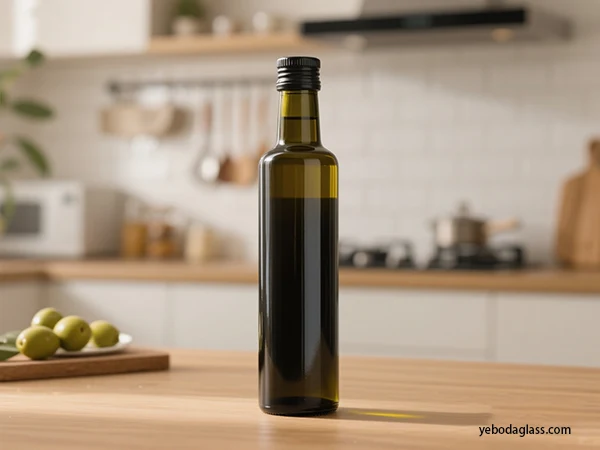
Yes. Dark colored bottles help to block the effects of ultraviolet exposure that can cause the degradation of polyphenols, vitamin E, chlorophyll stability and sensory quality during distribution.
For this reason, premium producers prefer dark packaging.
What is the best way to select the bulk olive oil supplier?
The food contact compliance, automated quality inspection, export expertise, stable production capacity, leak testing, and consistent packaging performance with internationally recognized quality management systems are all features a reliable supplier should possess.
When ordering volumes always ask for audit documents.
Final Thoughts
Your container design directly affects your product, how your product is perceived, logistics costs, and the satisfaction you achieve with your product. The most suitable container for an olive oil should be based on four considerations: (1) the characteristics of the material used for its construction, (2) its capacity of keeping the oil safe, (3) its capacity of ensuring the shelf-life of the olive oil and (4) the reliability of the manufacturing process, which is not only cost-related, but must also have a superior quality.
A trusted glass packaging supplier is an ideal choice to help reduce risk and improve product performance over the long-term when buying commercial olive oil retail and foodservice packaging.
 EN
EN  FR
FR  DE
DE  IT
IT  ES
ES  CS
CS  PT
PT  NL
NL  PL
PL  TR
TR  AR
AR  KO
KO  JA
JA  ZH
ZH  RU
RU  HU
HU